One thing among many that enthralls me in Will Barnet’s figurative paintings from the 60s on is the double-functioning contour lines that are especially well demonstrated in this work, The Blue Robe, 1962, which depicts his wife Elena and their daugher Una. The painting is consistently constituted of flat areas, so that his graphic lines model a form without shading. Each line, simplified to the utmost -- absolutely straight or otherwise curved with minimum undulation -- is therefore carefully deliberated not only to model a form, like the scoop on the right hem of her blue robe which brings out the swell of her breast, the slight dip in the line that defines the upper side of her arm down to the wrist, Una’s foreshortened thigh, and the subtle lift in the bottom line of the cushion on which she rests. But, most spectacularly, a single line often serves to define two forms simultaneously, like the underside of woman’s same arm which, resting on the shoulder of the sofa, also defines its upper ledge, the cat hanging on her knee, and the child’s right arm over her head. Barnet also likes to bring two lines, straight and curved, tangentially or nearly so, as in the woman’s left arm against her robe, the cat’s arched back against the sofa’s edge, and the girl’s buttock against her left arm. By this means the composition gains a tightly fit integration like that of clasped hands in which the two hands meet along a single continuous line, and the picture, seemingly simple, is infinitely intriguing. Will Barnet, now 101 years young (or, will be in May), just completed a selective retrospective at the National Academy Museum in New York, which illustrated the four phases of his pictorial career -- expressionist, para-cubist, figurative, and back to abstraction when he reached 80, curated with the same economy of means as the master’s art. Bless him.
Friday, January 6, 2012
Barnet's Contour Lines
One thing among many that enthralls me in Will Barnet’s figurative paintings from the 60s on is the double-functioning contour lines that are especially well demonstrated in this work, The Blue Robe, 1962, which depicts his wife Elena and their daugher Una. The painting is consistently constituted of flat areas, so that his graphic lines model a form without shading. Each line, simplified to the utmost -- absolutely straight or otherwise curved with minimum undulation -- is therefore carefully deliberated not only to model a form, like the scoop on the right hem of her blue robe which brings out the swell of her breast, the slight dip in the line that defines the upper side of her arm down to the wrist, Una’s foreshortened thigh, and the subtle lift in the bottom line of the cushion on which she rests. But, most spectacularly, a single line often serves to define two forms simultaneously, like the underside of woman’s same arm which, resting on the shoulder of the sofa, also defines its upper ledge, the cat hanging on her knee, and the child’s right arm over her head. Barnet also likes to bring two lines, straight and curved, tangentially or nearly so, as in the woman’s left arm against her robe, the cat’s arched back against the sofa’s edge, and the girl’s buttock against her left arm. By this means the composition gains a tightly fit integration like that of clasped hands in which the two hands meet along a single continuous line, and the picture, seemingly simple, is infinitely intriguing. Will Barnet, now 101 years young (or, will be in May), just completed a selective retrospective at the National Academy Museum in New York, which illustrated the four phases of his pictorial career -- expressionist, para-cubist, figurative, and back to abstraction when he reached 80, curated with the same economy of means as the master’s art. Bless him.
Thursday, January 5, 2012
Aquarius
It requires me an enormous effort to drink water habitually and to drink enough to reach the daily recommended quota, even in the summertime. I never liked to swim because I didn’t particularly enjoy soaking in the water and being splashed and, in fact, I barely know how to swim. I do bathe and shower out of necessity, however. When it rains, I hesitate to go out; I even change the plan when that is possible. I thought these quirks of mine arise from the fact that I am an Aquarius and come with plenty of water on my own. I like aquaria, however. That is because I don’t get wet. For the same reason, I enjoy immensely watching the rain out of the window, a drizzle, a downpour, or a hurricane.
The Enchanted Island
The Enchanted Island, the new pastiche opera at the Met, was striking, gorgeous, magnificent, totally enchanting, indeed, over the top. . . as a pastiche. But a pastiche it was, though the pieces were well put together, musically and theatrically, by the masterful hands of Jeremy Sams, with no unsightly seams in sight. Moreover, the production featured a parade of topnotch singers -- awesome David Daniels, powerful and beautiful Joyce DiDonato and Danielle De Niese, venerable Placido Domingo, and other impressive talents, and peerless William Christie directing. The use of the video projection of the 59 Productions was truly magical; and the lavish set and costume design was dazzling. The music drawn from Handel, Vivaldi, and Rameau, among others, was interminably a delight. Yet. . .and yet . . . it was a fragile contraption, a fairground festivity, a bouquet of tissue paper flowers, marvelous fireworks. It had little substance and got boring after the initial uplift; it was a marvel while it lasted but left very little after it was over.
Given all the splendor, it took me a while to determine the fundamental flaw, and I diagnosed it to be the excess of visual opulence. I’m no purist, and I understand pastiche as a legitimate creative style in the 18th century. and fantasy as a promising artistic form; and I know well that Baroque in art aspired for the splendiferous, even the stupendiferous. But the stage spectacle was overwrought to the point it was no longer an opera but a circus show at the expense of everything else -- the orchestra and, most of all, the contribution of beautiful singing talents. There was already an excess in wedding Shakespeare’s The Tempest and A Midsummer Night’s Dream; the effort undermined the depth of both plays and made us long for one or the other in its integrity. Ariel doubling as Puck is fun but no more than that. A show so rich and so cheap! A Baroque opera of more credible splendor was demonstrated by Lully’s Atys performed at BAM last September under the direction of the same William Christie -- a recreation of the 1987 production at Opéra Comique, Paris. No doubt The Enchanted Island was a great show, a masterpiece of its ringmaster, Peter Gelb. But if he thinks this project, surely costing a fortune, is going to create future opera fans, he might think twice because, most likely, any opera novice returning to the Met after this razzle-dazzle enchantment will only see any true opera pale as a spectacle and most likely disenchanting.
Tuesday, January 3, 2012
Movies: Hugo, A Separation, The Artist

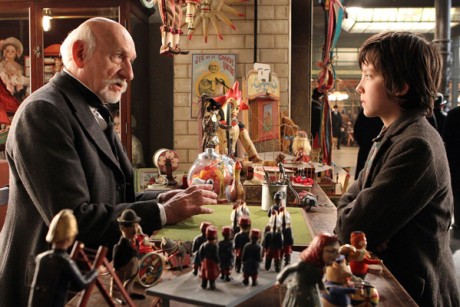
Braving the blistering cold down in the 20’s, I went out and saw two movies today. At AMC Loews Lincoln Square I viewed Martin Scorsese’s Hugo 3D. In view of this director’s earlier and even more recent films, Hugo is a gentle film without the intense emotional turmoil that was often his filmic hallmark. Essentially, it is his rumination on the origin of the cinema, the art to which he is deeply devoted, and, more specifically, a loving tribute to Georges Méliès (1861-1938), magician and the inventor of the narrative film, best remembered for A Trip to the Moon (1902), for which he exploited trick photography to magical effects. And, Scorsese shows himself a magician; he transports us into the world of fantasy imbedded in the eponymous child hero’s world of reality, and he uses the 3-D effectively toward this end. Hugo, an orphan, lives deep in the walls of the Montparnasse train station which shelter the huge mechanical contraptions that regulate the station’s clocks, and his single-minded pursuit of his father’s secret leads to the bitter old man tending a toy stall who turns out to be Méliès himself, played by Ben Kingsley looking deceptively like the filmmaker. Scorsese, in fact, sees the whole station as well as the city of Paris in 1920s and the life therein as a clockwork mechanism like that of the automaton, Hugo’s only inheritance from his father. The film takes liberty with chronology and geography. The runaway train that sped through the Gare Montparnasse and stopped hanging on its facade, of which a photograph exists, was a real event but of 1895; and Méliès was impoverished in 1920’s and it was not until after he was “rediscovered” late in the decade that he was provided with a comfortable retirement home, and that was in Orly. But this film is a fantasy, not history; still, it is infinitely fascinating, a special delight to the film buffs and historians among us.
P.S. Scorsese’s use of the 3D, to put it concisely, concerns space rather than motion. He eschews characters and objects that rush out toward the viewer explosively. Instead, he creates the effect of encompassing space (with the fluttering snow flakes that blow into the auditorium, for example, and Méliès’s sketches that fly off from the box that falls from the hands of Isabelle, the effect which accounts for our sense of being in the room) or, else, of clarifying the sense the narrowly confined space of the walled clock mechanism where Hugo lives. In the scenes of the station concourse he creates the credible impression that we are in the midst of the jostling crowd. I think his use of the 3D shows the understanding akin to that of the filmmakers known for the first creative adoption of the depth-of-field (or deep-focus) shots: William Wyler (with the cinematographer Gregg Toland) and Orson Welles. Scorsese creates an image of depth with both the near and the far in focus.
A Separation is a new film from Iran written and directed by Asghar Farhadi, is a moving story of a wife who seeks separation from her husband for the sake of their daughter’s education, which is denied at the court because he refuses to move from Teheran for the sake of his father suffering from Alzheimers, but the well-intentioned effort, both hers and his, leads to an expanding series of conflicts and clashes in all directions. I have not seen any of his films before this one. The story is well written, seamless in continuity and suspense and engaging as well as touching; and the theme is universal in interest, if also a glimpse into the contemporary urban life in Teheran is refreshing. But the very special beauty of this film is the craftsmanlike weaving of mundane or otherwise predictable events; the way it edits together bits of shots into a coherent but continuous series of events is reminiscent, even if the analogy is trite, of the Persian tapestry, or, even more in the narrative and stylistic precision, the Persian miniature, like the Shahnameh, in which the minutiae are as weighty as the large organizing forms and force us to read in paced sequence of small parts to get the sense of the whole. This is in striking and refreshing contrast to the grossly generalized and often unrealistically histrionic narration in many of the films of recent decades. God is, indeed, in the details. But, curiously, so is the indeterminacy of moral truth. We learn, living vicariously the life of the characters in the film, that no statement purported to be true is free of smaller elements which are not quite true or untrue, as no pictorial or filmic detail is ever complete in what it shows.
The Artist is by Michel Hazanavicius from Belgium, who also wrote and directed the film. I saw it three weeks ago. The story which describes the end of Hollywood’s Silent Era, involving its star George Valentin, a composite of Valentino and John Gilbert, and his young flapper partner Peppy Miller who rides the wave of the talkies to a great success, is told ingeniously not only mimicking the typical silent melodrama in the narrative of the hero's descent into poverty and attempted suicide but also realizing it nostalgically as a black-and-white silent feature, deliciously mawkish meta-cinematically, in both respect. I say meta-cinematically because the film does not attempt to recreate the movie in the silent era but rather comments on it as perceived by those who remember it as a myth rather than as a real experience in its time. It is another film that delights us film buffs and historians alike.
Monday, January 2, 2012
Sexy Sex
I’m by no means a prude. But I dislike the word sexy. I don’t consider it dirty; I don’t consider it vulgar; I don’t even consider it crude or unseemly, when used in its proper context, as of a sexy behavior, meaning carnal, arousing, lustful. Sex is sexy, after all. I dislike it because in current overuse of the word it has become as pale as nice; it has become colorless applied practically to anything nice -- eyes, shoes, cars, clothing, design, prose, ideas, mountains, pebbles, you name it.
There are evocative words that the word sexy as an umbrella term came to subsume and take over, oh, so rudely. A body may be voluptuous, a posture erotic, a face alluring, words seductive; a picture may be sensual or, otherwise, only sensuous, a relationship amorous, a story titillating, a scent provocative, a touch enticing, a pursuit passionate. Sexy? Blah.
Wenders' Pina

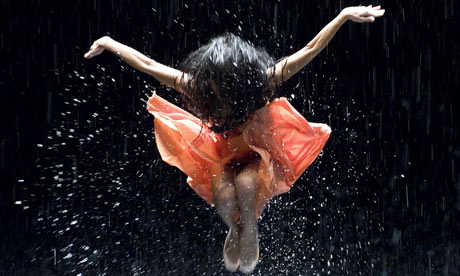
I went to see Wim Wenders’ new film Pina 3D, a documentary on the choreographer Pina Bausch and her Wuppeltal Tanztheater. The film as film is undistinguished, and the 3D technology added little to the power of her dances for those familiar with them in live theater. Still, the filmmaker’s ingenuity in piecing together a work from a project frustrated by Bausch’s sudden death in 2009 is admirable, combining dance footages with the dancers’ testimonials most effectively shown rather than spoken [that is, only as voice-over statements as though we are listening to their inner thoughts].
I have seen the Wuppertal performances in four programs: Für Kinder von gestern, heute und morgen (2004), Nefés (2006), Bamboo Blues (2008), and Vollmond (2010). Bausch’s dances are intensely dramatic; and they are drawn from a wide range of global sources. She is quoted as saying that she is “not interested in how people move but in what moves them.” If I were to give a single-word characterization, Bausch’s choreography is fury in contradistinction to Balanchine’s elegance, Robbins’ everyday, Mark Morris’ joyfulness, and Cunningham’s cosmic geometry. [Yes, Merce gets an extra word.]
Subscribe to:
Posts (Atom)