It's five days now since the Oscar 2017, and I happened to learn about the mishap climax at the Oscar ceremony this year, where a wrong film was announced as the best picture and watched a clip of the event. Well, that must have been some drama for the TV viewers of the ceremony. The Oscar has been a farce all these many years; but it has become a McCoy SLAP-STICK now. I have not seen either La La Land or Moonlight. But what an irony that the latter not only treats an African American life but features an all-black cast (so I just leaned, too) and won the award, ceremoniously sidestepped, following the years of Hollywood’s ethnic bias in nominations.
Showing posts with label Cinema. Show all posts
Showing posts with label Cinema. Show all posts
Friday, March 3, 2017


Friday, September 11, 2015
Authenticity, Credibility
Authenticity in acting is an oxymoron. A person can be authentic — honest, sincere and truthful. We can speak of the authenticity of a gem, a document, and a signature. A product can be authentic — genuine and unadulterated, true to what it claims to be. A painting deemed inauthentic is a copy, a replica, a workshop piece, a misattributed work, or else a work of forgery, But acting is feigning; therefore, the performer can never be authentic nor her or his performance. Its art consists in the ability of the actor to impersonate convincingly a character she or he is not. If successful, the actor achieves credibility, not authenticity but a semblance of authenticity or verisimilitude. There are people who fail to see this distinction.
It is absurd to expect an actor, who once or at the time was a hooker, promises to perform the role of a hooker better than anybody. If she played the character convincingly, the accomplishment owes to her acting, not her other profession. The actor can become a thug on stage or screen without being a thug in life.
A skilled Caucasian soprano can sing Aida and Madama Butterfly and act out the characters credibly; conversely, an African American, a Native American, a Latino or Latina, or an Asian can certainly successfully sing appropriate roles in Don Giovanni and Parsifal. Similarly, a a black actor can be cast and effectively perform King Lear and Oedipus Rex.
These are stylized dramas, of course. But it is no different in contemporary plays and films set in the contemporary world and realistically realized.
A controversy in Hollywood was reported recently in the New York Times article with the headline reading “Who Gets to Play the Transgender Part?” (3 September 2015). The answer to the question is: “Anyone who can should.” Refusing to answer the question decisively, the writer Mr. Brooks Barnes, muddled the issue. There is no question that the movie industry should seek out and use more minority actors with more effort — Asians, Blacks, Latins, Physically Challenged, Gays, and Transgenders, but not necessarily, I argue, in their corresponding racial, ethnic, and gender roles The confusion apparently issues from the community of transgender people pressuring the industry to cast transgenders in transgender roles. This is befuddling to say the least, or rather, downright silly, if we can assume, as I do, that a transgender man or woman striving to pass as the person of the opposite sex should welcome a non-trans actor assuming a transgender character.
We remember Theodor Bikel, a Jew from Vienna, was a Southern sherif in The Defiant Ones, 1958, and he was credible enough to be nominated the Best Supporting Role by the Academy; and Dustin Hoffman’s autistic savant in Rain Man won him his second Oscar.
As the Hollywood producers and directors interviewed in this article are said to have insisted: acting is acting. Indeed.
Wednesday, April 15, 2015
Jauja Film Poetry
The photographic camera, in its infancy, was believed to capture reality with such fidelity as no realist artist ever could, and so the movie through its history also saw realism as its special mission, and to this end the cinema for commercial consumption, on the one hand, pursued in its historical development the simulation of reality, first the sound in the talkies, then the technicolor, and more recently the wide screen and 3-D cinematography to encompass more of the real world, and, continuously favored, on the other hand, in the choice of subject matter, the narrative in the tradition of the novel, the realist storytelling, even in dealing with the material of documentation and of fantasy as in science fiction and digital spectacles. Various sound and visual effects and digital projection further enriched the cinemas presumed illusionistic character.
I found Jauja singularly remarkable in this regard, original in attempting a film that tries to be neither illusionistic nor novelistic despite the cinematically inevitable mimetic images, and it succeeds. First of all, it adopts the academy ratio rather the widescreen, which is the standard today, despite the panoramic landscape that the frame encompasses through the film. The frame, moreover, is given rounded corners going against the idea that what we see is fragment of the real world captured by the viewfinder; here, the image we see is an artifice. Jauja is also sparse with speech, with hardly any spoken dialogue in the main body of the film, and it is also parsimonious with music and other non-diegetic sound; and, little happens narratively, rendering the film excruciatingly boring to casual viewers. Without actions and events that develop a story, the images, staring at us, invite us to linger and experience imaginatively what is about to happen. This is poetry.
The first shot of any well-designed film serves as an intimation of the story and its mood in the film to follow, a sort of an overture. The first shot of Alonso’s Jauja (above) does more; it is, as we eventually find out, the summation of the entire film. Father and his daughter sit on the ground surrounded by a vast and open terrain. They sit close together but facing the opposite directions, they are close but apart, proximate yet distant, as she reads a book and he looks out toward the distance, alone together in the barren, forbidding landscape. The image expresses their mutual alienation most economically; as the film progresses we learn that this is what the film is all about.

The young daughter, fifteen as we soon learn, in response to her father’s ineffective caress leans on him and says that she would like to have a dog for her birthday. After a long pause, the father asks “What kind of dog?” and she explains “the kind of dog who follows me around everywhere.” The father is a general from Denmark who came to this South American hinterland to engage in the Spaniards’ territorial conquest in late 19th century. After a brief preliminary set-up in which we find the daughter elope with a young soldier, the film is the father’s seemingly vain search for her all over the wilderness, following her trail obsessively like the dog she wished for her birthday.
The endless pursuit, shown in interminable variations of the image of the man going round and round in the wilderness, is the substance of the film, and these images move slowly, and in their languid pace, engages the viewer to imagine, segment after segment, the potential narrative development. We are in suspense wondering what will happen next, and, given ample time, we keep thinking because we are never told. The images, in short, don’t illustrate the narrative, as films images conventionally do, but like framed paintings they only evoke narrative possibilities. Stated differently, the viewer, instead of being told a story, is teased into making stories. These are images that invoke imagination as no illustrative images in narrative films could. In this lies the peculiar richness and singularity of this film; it is a cinematographic poetry, an artistic construction only this medium and none other could create.
I’m looking forward to seeing Alonso’s earlier films — Los Muertos (2004) and Liverpool (2008).
Sunday, November 23, 2014
3-D Illusion
Cinema, since its inception, aspired for realism from the silent movie through the talkie and the technicolor to the wide-screen, the 3-D and the surround sound. But the 3-D effect is still only an illusion on the flat 2-D screen, an illusive reality masquerading to be real and deluding the spectator away from the hard fact that the world we experience in life is truly and really 3-D, be it a townscape or landscape, a street vista or an open field, wherever the real action is. A curious paradox, indeed.
Sunday, February 2, 2014
Dance on Film is Dance Film
I attended recently a program of twelve short dance films; some of these films recorded dancers dancing; others were film essays that happened to deal thematically one way or another with dancers or dancing, or else with characters who danced or events that included dance. The interest in all these films, regardless of quality, was the work as film, not as dance.
The distinction between dance on film and dance on stage (or in the open) is easily lost in this age in which we experience the world overwhelmingly through film, television, and digital media. I am no exception, for that matter, since it was my interest in dance that drew me to see these dance films. Still, the distinction is of paramount importance. A photograph is not the same as the painting it reproduces, however faithfully; it may present the subject and the general composition but fails to capture the palette, brushwork, and subtle details that distinguish the work. This can be said of photographs of any kind, too, which lose the surface quality when photographically reproduced in published books. This can be said, indeed, of photographs in relation to the real visual world; they are always selective and reproduce reality only so far. The distance between the work and the reality is even larger with documentary films; they may represent a scene or event but do not reproduced it. It is the witness role of the camera that misleads us. The camera was there to capture the scene, yes, but it also transformed it. As with dance, opera on the screen is a genre in its own right and should not be thought as another variant production. There is no question that it has its precious purpose of providing something of the experience of the opera to those without access to live opera performances. But it is a misguided notion to assume that one has experienced an opera without having seen and heard it performed on stage.
The problem extends to stages plays in general, of course, but especially with Shakespeare’s plays. I consider it preposterous to think one knows a particular Shakespeare play only on the basis of the filmed version as it is on the basis of the written text studied as literature.
I even extend my view of the primacy of visual and aural experience to live music performances as I wrote earlier in Looking while Listening. On further thought, I observe that a public lecture heard and viewed as a talking head on TV or video may be substantially the same lecture as the one experienced live in an auditorium but lacks the totality as an experience, which accounts for the full and vivid reality that in the first attracted its willing audience.
One of the best dance films I have seen recently is David Fishel’s Hästdans på Hovdala, which documented the rehearsal process of the outdoor dance performance choreographed by JoAnna Mendl Shaw of The Equus Projects (which combine dance with equestrian artistry), which in this instance also involved young people of autism. It dealt with the making of a dance as the subject and showed clips of the finished dance performance only perfunctorily at the conclusion of the film. Shaw’s choreography, as captured on film, is superb; but it is first and foremost an excellent film.
Tuesday, November 19, 2013
Movies hardly now
In mid-career, teaching film courses, I watched loads of films, well over 200 in most years — in theater, on videocassette, and on television (particularly, on the stations Bravo and Turner Classic for oldies). The number diminished toward the end of 1990’s to a hundred or fewer. But after my retirement in 2001, the number went down further to 50 in good years, and more recently barely a dozen.
Living in New York, I cannot imagine ignoring the live performances this city uniquely has to offer in abundant variety. Why spend more time and expense at the movies when films remain accessible on DVD, as they do today, long after their release, and stage shows vanish after a given number of days or weeks never to be retrieved later. Unless profession or social fitness, so to speak, demands us to be cinematically au courant, we'd be wasting the city's valuable resources otherwise. So, opera, ballet, dance, music, and stage plays solidly fill up my calendar; I go to movies lately only when urged by friends.
This is as good a reason as any why I give more time to live theater, even though it is true that I love theater, its breath and immediacy and brought me to New York as my place of retirement in the first place. I will return to watching movies on DVD when I am old and feeble and can no longer go out comfortably,
Tuesday, January 15, 2013
Haneke's Amour
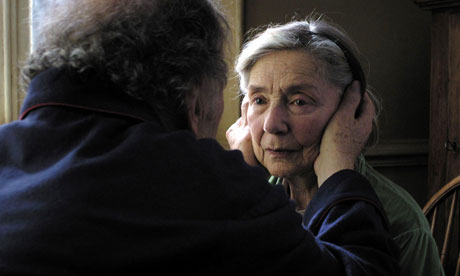
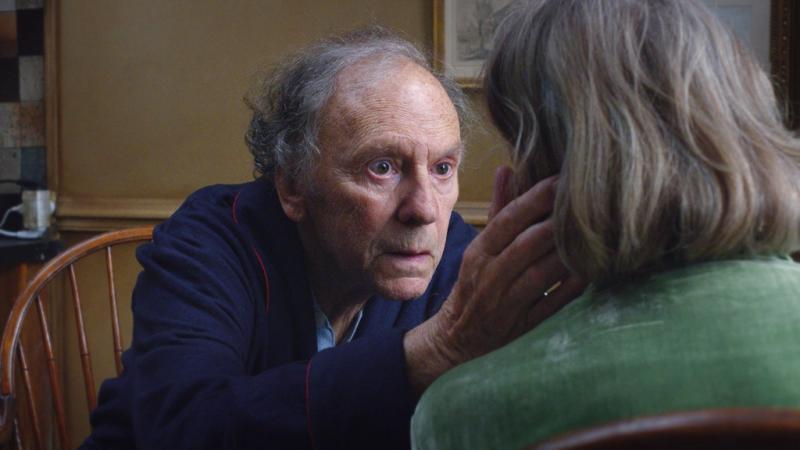
Michael Haneke’s latest film, Amour, is a gracious downer gracefully crafted. It is a story of an aging husband as a caretaker of his slowly declining wife, too familiar to too many and possibly too painful for many in the audience to watch. Yet it is interminably engaging, deeply felt, and long remembered. Haneke eschews melodrama by preparing the viewers to go slowly. How he does it impressed me most of all.
He opens the film with a pre-credit scene of Georges's dead body discovered by firemen breaking the doors into the couple’s apartment; he places the narrative conclusion at the outset (as Hitchcock often does) and he does so to prevent us from chasing the narrative as a suspense (unlike Hitchcock). The body lies peacefully, and we are given no clue as to how he died. In the first scene after the credit, we see a concert hall straight on in a long shot staying on for a long time so as to allows us to scan and take time to find Georges (whom we have seen so far only briefly) and Anne (whom we have not yet seen), listening intently to Chopin being played on the stage off screen. He thus trains us to watch the film without rushing, in the pace simulating effectively Anne’s slow physical deterioration. Then, through the course of the film, he maintains preference for static camera and long takes; the camera’s intense gaze, unblinking and caressing, records meticulously and matter-of-factly the mundane activities of caring with the same tender patience of Georges looking after Anne, paying the same close attention to details as he does and thereby making tactile without sentimentality his deep genuine love for her.
At the time of filming, Jean-Louis Trintignant in the role of Georges was 81; Emmanuelle Riva as Anne, 84. I barely recognized him from his screen image I was familiar with from 1969/1970: Z, Ma nuit chez Maud, and Il conformista. I could not recognize her at all from Hiroshima mon amour (1959) or even from Kieslowski’s Blue (1993). To see them was a special pleasure; but their performance was totally stunning, as impressive as Haneke’s direction, and so was Isabelle Huppert as the couple’s alienated daughter.
Saturday, January 12, 2013
Marclay's Clock
Christian Marclay’s Clock makes us live aware of every minute of each hour minute by minute with a shot or a short sequence of shots culled from a vast array of films, old and new, mostly American. It was first exhibited at Paul Cooper Gallery in Chelsea back in February 2011. Last week I sat through two and a half hours of its 24-hour loop at MoMA from 9:35 to 12:05. To say it was an enthralling experience is understating it.
The film is composed of at least 1440 pieces of film, if we count one shot a minute, each with a timepiece of one sort or another -- a clock or a watch, or else, spoken words saying the time; but actually it contains at least twice that number in all because there are shots without any timepiece, too. The sheer task of
compiling and splicing them is a heroic act of patience. But, above all, the continuity that accomplishes a semblance of narrative is truly breathtaking. For example, a woman knocks at an apartment door; the cut shows the interior and a man opening it but this is from another film. Similarly, a man starts a car, checks his watch, and then the next shot shows another car speeding on a highway with a different character at the wheel from another film. A woman pours tea but another woman drinks it in different setting of another shot. Different segments from one film are at times distributed over a length of passing time, some without a time piece in it, but always synchronous with the real time regardless.
Ideally, one should view it in its entirety, all day and all night, or at best, say, from 5:00 a.m. to 2:00 a.m. continuously. Otherwise, one should catch in two to three hour segments several times to cover as much of the whole film. A DVD version of the film would be impractical without a means of synchronizing it with real time. But a catalogue raisonnée listing all the filmic sources minute by minute would be useful for film buffs, for whom the work is an inexhaustible source of pleasure. Even within my two-and-a-half hour of viewing, I recognized, without being able to identify immediately, numerous films from my stock of knowledge. It was a tremendous pleasure to encounter familiar faces of actors from the past, near and remote, even if, again, I was unable to quickly remember their names since the shots are flashed only instantaneously and go fast.
In the course of two-and-a half hours we are also made aware of the situations when we are alert to the elapsing time; awakening in the morning or from a nap, waking someone up, going to work or school, waiting for and catching a bus or train, a rendezvous of all kinds -- an appointment, a date, a tryst, a conference, a meeting, and any consorted action requiring the watches to be synchronized, completion of a task, looking up a large clock in a public place, like the Big Ben, and later in the day, getting up to start cooking dinner, checking on the return of a family member, remembering a TV program to watch, the movie showtime, or a curtain time at a theater, preparing to hit the sack, and waking up in the middle of night. Conversely, we are reminded of those instances when we forget the passing of time as when we are deeply engaged in work, play, reading, or daydreaming.
Daydreaming, indeed, quite aptly describes the experience of watching Christian Marclay’s cinematic masterpiece, Clock.
Wednesday, August 15, 2012
Movies - Woody, Lepage, Ai Weiwei, Fokkens
Theater is slow in August Off-Broadway, so with some evenings free, I was able to pick up a few 2012 movies.
Last Monday, I finally caught up with Woody Allen's To Rome with Love. My immediate reaction was “a fluff, vacuous and vapid” without the recognizable and interesting characters from the 20s that populated Midnight in Paris; still, on reflection, I give the director a credit for his masterly control editing the seemingly haphazard narrative segments to flow into a continuously entertaining entity. Rome’s sights were washed out and lacked visual excitement unlike the Midnight’s Paris.
Susan Frömke’s Wagner's Dream is a documentary on the new production of the Ring at the Met, an extravagant venture by Robert Lepage, who got flacks from critics, a damage control and publicity relations effort to promote how the Met is adventurously and successfully keeping the Met abreast the technocratic 21st century and justifying the project as a full realization of Wagner’s dream of Gesamtkunstwerk for the Ring, the proposition that rings false if we remember his own production at Bayreuth where music reigned supreme and would not have allowed a spectacle to overrule it. I would call the film Lepage’s Fantasy. But a glimpse into the process of a production in the making, especially in the Met’s backstage made a good Wagnerian drama.
Then, I saw Ai Weiwei: Never Sorry, a documentary on this dissident artist in China, which, if a bit fawning overall, still powerful thanks to the artist’s inimitable persona and presence; it is a familiar story but for a non-TV owner like myself it was good to see the person, his cohorts, his studios, and demonstrations, exhibitions, and interviews.
The fourth film, a Dutch import, Meet the Fokkens, the original title of which is Ouweheuren (old whores), is another documentary on two 70-year old twin prostitutes, one retired and the other still working, in the notorious De Wallen, Amsterdam’s Red Light district. I found it charmingly uninhibited and noteworthy for the two aging women’s contagious joie-de-vivre and their dedication to each other heartwarming.
Monday, February 6, 2012
Zdenka's Terezín
Two weeks ago I went to 92nd Street Y and saw the documentary film, The Music of Terezín, which had its first public screening in North America. It was made in 1992 and shown on the BBC the following year. Simon Broughton, a British TV director, has a special interest in world music, and made documentaries on famous composers as well as Fado and the Sufi music. The story of the concentration camp is well known; the Gestapo made into a ghetto the fortified garrison town at Terezín (then known as Theresienstadt) where Jews from Czechoslovakia and surrounding areas were brought in to live before they were sent to Auschwitz-Birkenau. Broughton’s film portrays the creative life of composers and performers who continued to produce music under the horrendous living conditions that could only be described as subhuman. Yet, the musicians smuggled instruments, often in parts to be assembled in the camp and performed the music the composers wrote, at first in secrecy but later more openly as the Nazi supervision changed its tune. It was a beautifully crafted film, lucid and informative in its narrative, supported with interviews with surviving witnesses. Most of the interviewees have passed away since 1993. One of them, a Czech actress Zdenka Fantlová, accompanied the director who conducted a discussion after the film.
At 88 or 89, Fantlová was still beautiful, articulate, and high-spirited. She confirmed that neither she nor anyone else knew where the “train to the East” went. But in 1944 she was on the very last transport train to Auschwitz together with most of the musicians who eventually perished there. On arriving at Auschwitz, she managed, by falsifying her age, to be sorted to the group destined to the labor camp rather than the gas chamber, and survived. She told the audience emphatically that although the life was miserable in the camp, instead of dwelling on it, she learned a valuable lesson how to live the precious life fully day to day. Her words struck a chord in me, as I, too, lived the war years, certainly less horrendous but equally terrifying and deprived. In 2001 she wrote an account of her life during the war entitled My Lucky Star (after a Fred Astaire song), originally written in Czech in 1997. Then, in 2010 she had it updated and republished as The Tin Ring. I bought a copy, had it autographed by the author, chatted with her, and shook her hand. It was for me a terribly emotional, intensely moving experience.
I asked Broughton why the documentary slept all these 19 years, and he said that there was no interest. I did not have time to pursue the question. But I speculated that in these intervening years, the audience demanded and expected that the films that dealt with concentration camps focused on the horrors of the Holocaust and presumably found one that portrayed music-making at Terezín, even under the adverse condition, insufferably frivolous. Some may even have seen it as a gentle denial of the truth of the Holocaust, aligning it with the heavily-faked Nazi propaganda film showcasing Terezín for the Dutch Red Cross as a happy internment town. There were questions from the floor, in fact, asking to give (for the benefit of the audience) more details about the miseries in the camp life. Only in recent years, the works of the Terzín composers came to be recorded and publicly performed -- Viktor Ullman, Pavel Haas, Giedion Klein, and Hans Krása, among them, some of them students of Schönberg and contemporaries of Janacek. Time may be finally ripe for a larger audience appreciating the film that extols the courage, strength, and irrepressible creativity of those musicians (and actors and artists, too) of Terezín -- Zdenka’s Terezín.
The film The Music of Terezín was discussed at some length in The Observer/The Guardian at the time it was shown in England in 2010. See: http://www.guardian.co.uk/world/2010/jun/13/terezin-ghetto-jews-holocaust-vulliamy.
Sunday, February 5, 2012
Bresson's A Man Escaped
Bresson’s films are insistently anti-narrative even though they may appear otherwise. I have already written how he subverts the convention of realism in the images he uses, and directs us to an experience that transcends reality. A Man Escaped, 1956, more than any other film of his, tempts the audience to see it as a neorealist narrative because it is nominally a thriller describing an escape from a prison; and it suspensefully engages the audience from the beginning to the end.
But, as a thriller, A Man Escaped is shoddy. What Bresson shows in 102 minutes is significantly uneventful; it consists of preparations for the escape but lacks large events, like a near exposure, a near escape, and a reverse of fortune. There are no large actions -- no accident, no scuffle, no fracas, no chase. Throughout the film, the camera focus on the face and hands of the prisoner Fontaine as he chips away the wall with a spoon, tears shirts into strips and braids ropes, and makes makeshift hooks; it veers away from him only occasionally, no more than absolutely necessary. His interaction with other inmates is sketchy; dialogues are minimal.
The screenplay, written by the director himself, was adapted from the real event, an account by André Devigny himself of his escape from a Gestapo prison in Lyon; and Bresson was meticulous in shooting on location and recreating the replica of the cell as well as the details of the costume and props, even using the ropes and hooks used by Devigny that had been preserved.
Documentary in visual style, the film nevertheless fails as a documentary film; the geography of the prison complex, even of Fontaine’s cell, is never made very clear. Then, the voice-over narration, instead of establishing a narrative continuity, elaborates only in segments, what the images informs us. In the filmmaker’s own words: “Image and sound must not support each other, but must work each in turn through a sort of relay.”
The suspense we experience comes from the intensity of attention on the small cumulative actions, not from the overarching adventure. We know from the start that Fontaine escapes. The title announces it; it is more explicit in the original French title: Un condamné à mort s’est échappé. Bresson’s interest lies not in the actions shown per se but the obsession of bewildering depth in which we are forcibly made to partake in and experience. It is toward this end that he deploys the realism of the documentary style, strikingly in opposition to what was conventionally developed to bring us close to the empirical reality -- the impression of being there and then ourselves; instead, he shows an experience beyond its surface and insists that what seems ordinary is extraordinary. Something transcendental guides Fontaine to the escape he prepares for, without his being quite aware of it, and the final escape is a liberation as of death itself in Bresson’s other films.
The full title, in fact, reads: Un condamné à mort s’est échappé, ou le vent souffle où il veut. The second title comes from St. John 3:8, which translates as “The wind bloweth where it listeth” in King James, and “The wind blows where it wills,” in a modern version. What completes the verse, well understood in the phrase, is profoundly significant: “. . . and thou hearest the sound thereof, but canst not tell whence it cometh, and whither it goes; so is every one that is born of the Spirit.”
Tuesday, January 24, 2012
Bresson's Cinema
Those who are new to Robert Bresson will mostly find his films excruciatingly boring. Those who have known some of his best films, say, A Man Escaped, will find them intensely engaging, despite the seemingly uneventful progress, drawn by a certain obsessive anticipation, rather like waiting for Godot.
For two weeks the Film Forum screened his thirteen films, virtually his total output between 1943 and 1983, some of them for only one showing. I was able to see ten of them one after another, and the experience prompted me to note that the divided reception was a clue to the nature of Bresson’s cinematic art.
Briefly stated, one most conspicuous peculiarity of his films is that, whereas his screen images are uncompromisingly realistic, the film composed of them does not replicate reality credibly. The characters he constructs appear confused or even irrational, and he does not develop them narratively; very little happens in the film though what happens is described with stubborn persistence. So, it bores us, or else intrigues us and keeps us waiting. There is very little story in any of his films, the barest minimum of a plot only as inevitable.
Film for most people is narrative, and historically, with rare exceptions, film has always been narrative. Fiction or non-fiction, a film tells a story with images, dialogues, and narrated words, and actors impersonating characters or real personages acting themselves to develop an event of some interest. A documentary constructs a story as narrated by the documentarist or encapsulated in her or his point of view; a surrealist film, like those of Renais Clair and Buñuel, in its lack of coherence, did not fail to narrate the events in the subconscious world. A film without a story is a failure, and it bores the audience. Bresson fails to narrate and is not even abstract or surrealist.
From the middle of the 20th century, some filmmakers, as in Neorealism and the New Wave, moved away from the earlier theatrical artifice toward naturalism in pursuit of greater immediacy in the narrative. Fictional films began to adopt the documentary style, preferring to use the natural light and location, non-professional actors, loose plot construction, casual dialogues, and even a hand-held camera.
Bresson began to adopt some aspects of this style in his works starting with Le journal d’un curé de campagne (1951), the style ventured earlier by Vittorio De Sica in Ladri di biciclette (1945), in which the filmmaker creates a strong sense of the event as it might have happened in the real world familiar to the audience and makes the story more credible even though it is fictional. Bresson’s Le journal endows the images with a strong sense of reality -- of specific time and place; and yet the film feels removed from reality. In most of his films, there is only one protagonist on which the filmmaker’s interest rests. The narrative is thus biographical but only nominally because the scenes are arranged episodically rather than progressively. That is to say, though Le journal is nominally the story of the country priest’s life which starts with his arrival in the remote village and ends with his death, the events in his life, despite the voice-over reading of the diary, are given in haphazard episodes. The film minimizes the story and constructs something that is better described as a portrait.
The non-sequitur selection of episodic events is even more pronounced in Mouchette (1967), his last black-and-white film, in which the sequence of scenes contribute little to any recognizable passage of time; instead, they construct the living portrait of the girl lost in her world she barely comprehends. In both of these films the protagonist dies, as in most of his films, and the ending is not so much the culmination of her or his biographical life but more like a consummation of a life guided by some mysterious power above and beyond reality, comparable to the end of Joan of Arc on the stake after the trial in Le procès de Jeanne d’Arc (1962), nominally an event occurring in real time of the trial but, austerely reduced in action and setting, is characteristically a portrait in contrast to even Dreyer’s rendition of the saint.
In all his films, we can say, that Bresson, endeavors to minimize whatever contributes to the narrative fulfillment in the film, despite his insistence on the realism of the images, which was developed to enhance the realism of the story in Neorealism and the New Wave. For the length of the film our narrative interest is thus suspended, and we wait and wait, bored or intrigued, and the end is death, which somehow gives the meaning, not quite comprehensible to us no less than to the portrayed personage but somehow physically felt as an unforgettable experience, a meaning mysterious, perhaps transcendental, like Joan’s death on the stake, a salvation, in a deeply Catholic way of thinking ingrained in Bresson’s life.
The beings that Bresson captures in his film-portraits engage themselves almost blindly in what they do, docilely or else obsessively, as though guided by some power beyond their comprehension, transcending their activities. A mystery is a mystery because it is not totally comprehensible in a rational way; it reaches above and beyond our everyday experience, beyond what language can express. Mystic writers don’t describe but evoke their experiences, well aware of the limits of the words, and expect the readers to capture the mystery beyond comprehension. Poetry is, in fact, like that when it succeeds brilliantly. So, Bresson tries through his filmed images beyond what the images naturally communicate. He eschews symbolism, however, because his aspiration is not abstract ideas but some concrete experience of the transcendental; for this reason, realism of the images is essential to him. He does not construct a story; he does not replicate our reality; he uses the images of our everyday world to search for a meaning that somehow elevates us. It is not surprising that Bresson’s films demand to be seen repeatedly to be experienced more deeply fully.
In one of the oft-quoted epigrams, Bresson wrote: “A movie is born first in my head, dies on paper; is resuscitated by the living persons and real objects I use, which are killed on film but, placed in a certain order and projected on to a screen, comes to life again like flowers in water.”
Tuesday, January 3, 2012
Movies: Hugo, A Separation, The Artist
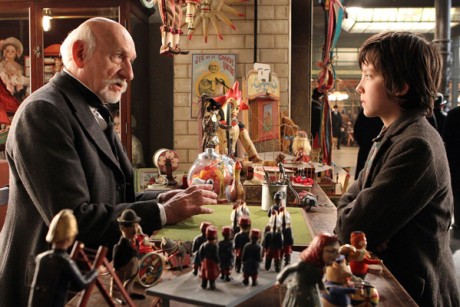
Braving the blistering cold down in the 20’s, I went out and saw two movies today. At AMC Loews Lincoln Square I viewed Martin Scorsese’s Hugo 3D. In view of this director’s earlier and even more recent films, Hugo is a gentle film without the intense emotional turmoil that was often his filmic hallmark. Essentially, it is his rumination on the origin of the cinema, the art to which he is deeply devoted, and, more specifically, a loving tribute to Georges Méliès (1861-1938), magician and the inventor of the narrative film, best remembered for A Trip to the Moon (1902), for which he exploited trick photography to magical effects. And, Scorsese shows himself a magician; he transports us into the world of fantasy imbedded in the eponymous child hero’s world of reality, and he uses the 3-D effectively toward this end. Hugo, an orphan, lives deep in the walls of the Montparnasse train station which shelter the huge mechanical contraptions that regulate the station’s clocks, and his single-minded pursuit of his father’s secret leads to the bitter old man tending a toy stall who turns out to be Méliès himself, played by Ben Kingsley looking deceptively like the filmmaker. Scorsese, in fact, sees the whole station as well as the city of Paris in 1920s and the life therein as a clockwork mechanism like that of the automaton, Hugo’s only inheritance from his father. The film takes liberty with chronology and geography. The runaway train that sped through the Gare Montparnasse and stopped hanging on its facade, of which a photograph exists, was a real event but of 1895; and Méliès was impoverished in 1920’s and it was not until after he was “rediscovered” late in the decade that he was provided with a comfortable retirement home, and that was in Orly. But this film is a fantasy, not history; still, it is infinitely fascinating, a special delight to the film buffs and historians among us.
P.S. Scorsese’s use of the 3D, to put it concisely, concerns space rather than motion. He eschews characters and objects that rush out toward the viewer explosively. Instead, he creates the effect of encompassing space (with the fluttering snow flakes that blow into the auditorium, for example, and Méliès’s sketches that fly off from the box that falls from the hands of Isabelle, the effect which accounts for our sense of being in the room) or, else, of clarifying the sense the narrowly confined space of the walled clock mechanism where Hugo lives. In the scenes of the station concourse he creates the credible impression that we are in the midst of the jostling crowd. I think his use of the 3D shows the understanding akin to that of the filmmakers known for the first creative adoption of the depth-of-field (or deep-focus) shots: William Wyler (with the cinematographer Gregg Toland) and Orson Welles. Scorsese creates an image of depth with both the near and the far in focus.

A Separation is a new film from Iran written and directed by Asghar Farhadi, is a moving story of a wife who seeks separation from her husband for the sake of their daughter’s education, which is denied at the court because he refuses to move from Teheran for the sake of his father suffering from Alzheimers, but the well-intentioned effort, both hers and his, leads to an expanding series of conflicts and clashes in all directions. I have not seen any of his films before this one. The story is well written, seamless in continuity and suspense and engaging as well as touching; and the theme is universal in interest, if also a glimpse into the contemporary urban life in Teheran is refreshing. But the very special beauty of this film is the craftsmanlike weaving of mundane or otherwise predictable events; the way it edits together bits of shots into a coherent but continuous series of events is reminiscent, even if the analogy is trite, of the Persian tapestry, or, even more in the narrative and stylistic precision, the Persian miniature, like the Shahnameh, in which the minutiae are as weighty as the large organizing forms and force us to read in paced sequence of small parts to get the sense of the whole. This is in striking and refreshing contrast to the grossly generalized and often unrealistically histrionic narration in many of the films of recent decades. God is, indeed, in the details. But, curiously, so is the indeterminacy of moral truth. We learn, living vicariously the life of the characters in the film, that no statement purported to be true is free of smaller elements which are not quite true or untrue, as no pictorial or filmic detail is ever complete in what it shows.

The Artist is by Michel Hazanavicius from Belgium, who also wrote and directed the film. I saw it three weeks ago. The story which describes the end of Hollywood’s Silent Era, involving its star George Valentin, a composite of Valentino and John Gilbert, and his young flapper partner Peppy Miller who rides the wave of the talkies to a great success, is told ingeniously not only mimicking the typical silent melodrama in the narrative of the hero's descent into poverty and attempted suicide but also realizing it nostalgically as a black-and-white silent feature, deliciously mawkish meta-cinematically, in both respect. I say meta-cinematically because the film does not attempt to recreate the movie in the silent era but rather comments on it as perceived by those who remember it as a myth rather than as a real experience in its time. It is another film that delights us film buffs and historians alike.
Subscribe to:
Posts (Atom)

