Showing posts with label Art. Show all posts

Thursday, March 28, 2019

Caravaggio, Caravaggesque

A painting depicting Judith Beheading Holofernes, found in an attic in France in 2014, surfaced in auction recently as a long lost Caravaggio, so attributed by experts (ArtNet News, 28 February). 


Image result for Caravaggio attribution  judith and holofernes

One should not judge without seeing the original.  But my immediate instinct, on the basis of the reproduction, is that it is No Caravaggio. I don't know why the so-called experts look at the brushwork and details with close attention, and they are not to be disregarded, but not at a large picture, so to speak.  I find the composition and the chiaroscuro in this painting unconvincing.  
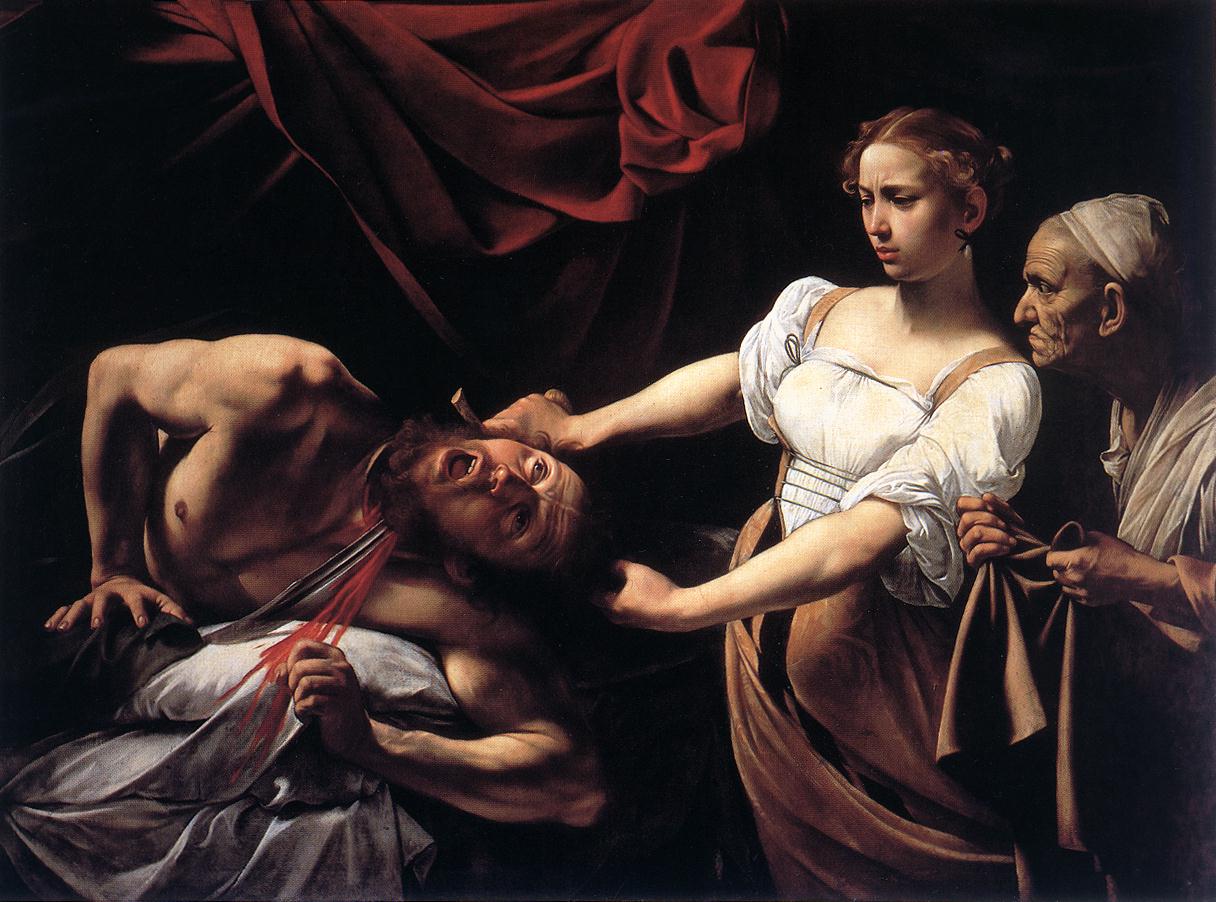
The difference becomes immediately clear when we compare this painting with Caravaggio’s own, 1598-99, now in the Galleria Nazionale d’Arte Antica in Rome. 


Image result for Caravaggio judith and holofernes


In the recently attributed painting, Judith’s hands are hard to see; in Caravaggio’s own, her bare arms are centrally placed with her right hand gripping the sword and the sword inserted deep into Holofernes’s neck.  The viewer's eye is thus immediately drawn to and held in Judith's action.  Her expression is calm and determined.  In the attributed work, the servant breaks the relationship between her mistress and the victim, so powerfully depicted in the work of the master.   Then, Caravaggio’s reputed dramatic chiaroscuro, of which definition Caravaggio changed in practice from a mere light-and-shade, that is, chiaro + oscuro, to theatrical illumination, makes Judith the unmistakable protagonist.  It is noteworthy, too, that Judith, clad in white here, is robed in black in the less competent composition.  The dramatic chiaroscuro becomes prevalent in Caravaggio’s work after 1600 regardless of the subject matter. 

While a good artist can occasionally produce less competent work, these two points, the composition and chiaroscuro, disqualify the recent discovery to be considered Caravaggio’s own.  


Image result for Artemisia Gentileschi judith and holofernes

We may further observe that Artemisia Gentilleschi who also painted Judith Beheading Holofernes in 1620 (The Uffizi), fully understood Caravaggio’s chiaroscuro, though she resorted to a different compositional strategy by having the servant helping her mistress by holding down the victim and thus clustering the three figures into a single powerful dramatic action. 


03.15.19 

Tuesday, November 27, 2018

Pontormo's Visitation

Jacopo Pontormo’s Visitation or Miraculous Encounters (1517) from the Church of San Michele e San Francesco in Carmignano near Florence, recently cleaned and restored and brought to The Morgan Library and Museum, is a rare masterpiece, most significantly in the artist’s completely new treatment of the subject matter. 

The Visitation, recounted in Luke 1, 39-56, concerns Mary’s visit of her cousin Elizabeth who was six months pregnant (with John the Baptist) shortly after the Angel’s Annunciation of the Virgin’s Immaculate Conception. Traditionally, before Pontormo, the subject was pictorially rendered as a narrative, as we see, for example,   in the Visitation by Giotto in the Arena Chapel (1303-06) and something like the one by Marx Reighlich (1485).
Related image


Pontormo, instead, focused on the psychology of the protagonist, Mary. The setting is abstract and the group is arranged in stop action.  The two attendants, presumably one for Mary and the other for Elizabeth, instead of standing behind their respective mistress in proper obeisance, stand guard upstage, looking straight out of the picture but unfocused, rather like two prison guards, between which Mary’s face, itself shaded in contrast to the better lit three other faces, is uncomfortably hemmed in, illustrative of her anxiety in her plight of unexpected pregnancy. Her unease is further demonstrated in the drapery over her shoulder in notable disarray, and one of her feet almost catches the hem as though she might trip and loose her balance. The four figures are placed in a tight rectangle and efficiently dissuades the viewer’s narrative reading. 

The psychological iconography is clear and powerful.  This is what makes this Visitation, in my opinion, a remarkable masterpiece.

11/27/18

Friday, January 20, 2017

Pictures titled Untitled

“Untitled” as the title of a painting irks me so.  What?  “Untitled, is it?  But isn’t this a title?”  This is a contradiction akin to the Cretan Liar paradox.  We find on a page of certain official documents a warning, announcing prominently: “This page was intentionally left blank.” Oh, sure, except for this notice which makes the page no longer blank. 

Worse than “Untitled” is the title “Untitled” followed by a phrase in parentheses, such as “Untitled (Mother’s Garden in May)” or “Untitled (Flight/Fright).”  This is a double contradiction, saying that the painting is untitled but not really.  The painter is muttering to herself or himself: “Well, yeah, I don’t know, like, I don’t have a title but it’s kinda like something in my mind, you know, I’m not quite sure what, yeah, but heck here it is, um, make of it what you will.” 

As a title “Untitled” could mean “still untitled,” that is, not yet titled.  In that case. “Work in Progress” is more accurate as in a portion of a novel sent in to a journal for publication.  No publisher, however, will accept a manuscript titled “Untitled,” nor a play so titled will ever be put on stage. Imagine a marquee “New York Premiere Albee’s latest play ‘Untitled’”. Musical compositions without a narrative theme came to be identified by the instrument/s and key signature: Violin Concerto in A-minor, String Quartet No. 4 in G-major., etc. 

Historical paintings, that is, narrative paintings -- religious, mythological, or historical -- as those in the Renaissance, did not require titles since the subject depicted was obvious to the viewer: St. Catherine,  St. Jerome in his Study,  Rest on the Flight into Egypt, Danae, Fall of Phaeton, Diana and Actaeon, etc.  In the 17th century in Holland, when marketing of art came into being, titling became useful, especially with the proliferation of non-narrative subjects -- portrait, landscape, still life, and genre (scenes from everyday life).  Thus, we find identifications like “River Landscape with a Ferry,” “A Gypsy Girl,” “Still Life with Eels,” “Ontbijt (Breakfast),” etc. Titling became a necessity in preparing inventories after the death of the artist.  Subjects outside the established genres were unwieldy.  Watteau’s reception entry he submitted in 1717 for admission to the Academy was called  “La fête galante” when exhibited, as it didn’t fit any existing subject category; it was neither history nor mythology, nor genre.  The exact subject is still debated: Embarkation for Cythera or Departure from Cythera.  With the rising practice of artists inventing a new subject for each painting, together with the new tradition of public exhibition of art, titling paintings became a necessity and a norm.   

The motivation for titling a painting “Untitled” is understandable and justifiable. Titling a painting implies that it has a subject -- literary, poetic, or thematic. It describes the work summarily, or, at least, provides a key to its meaning.  The idea of titling a work “Untitled” is to eliminate narrative connotations and force the viewer to look at the work and read its theme and meaning in the painting itself.  Pursuing abstraction, Kandinsky resorted to musical analogy in his titles: “Composition No. 5,” like the opus number in music. Some later non-figurative painters, just gave numbers, like, “Number 15” (Rothko), colors, like “Russet (Morris Louis), ” or the source of abstraction, like “Cathedral” (Hofmann), though others continued to give literary titles, like “Lucifer” (Pollock) and “Empress of India” (Stella).  If the painter feels strongly that the work should not be titled, she or he should call the work “Painting” rather than “Untitled.”

The one time I was made keenly aware of the perfect rightness of the title “Untitled” was at the exhibition of the works of Agnes Martin’s paintings, which she consistently and most deliberately titled “Untitled.”  From one painting to the next, identical in size and subtle in difference, at a glance they look alike; it is only on intense inspection the strong presence of each, which gives each work its unmistakably identity, impresses the viewer and makes it unforgettable.  Each painting identifies its visual reality that no lengthy description, not to speak of a title of any kind, can ever communicate profitably; it is revealed only in concentrated and prolonged and seeing.  Not all non-figurative paintings share this concrete optical quality.

Then, more recently, at the exhibition of Cindy Sherman’s photographs, I was equally impressed by her “Untitled” titling of her series “Untitled Film Stills.”  Her self-portraits as fictional but plausible film characters might be identified as types, like “tired housewife.” “young hitchhiker.” “sex kitten,” or whatever, but any title with a literary or cinematic reference only detracts from the specific identify of each feigned character, its immediacy (even though distanced as a screen image, simulation as it may be).  This observations holds, too, for Sherman’s later photographs of “society women, “centerfolds,” and “historical characters.”  Moreover, any specific title is not only redundant but falsifying since the reality of her photographed images is double-layered: one of her self-representation in different guises and the other of the character she is donning.  Her photographs simultaneously draws our attention to the persona as a person and the persona as a mask  In later works, in fact, she makes her prosthetic applications deliberately visible to distinguish the two layers of representation.  Strictly figurative, unlike Agnes Martin’s paintings, Sherman’s photographs are strong by virtue of their unmitigated specificity. 

In these examples, the title “Untitled” means “No other title was adequate” and not  “No title was conceived,” that is to say, concrete rather than abstract.

Too often, I still contend, paintings of vague or blurred identity are lazily left “Untitled”, and they vex me. 

Tuesday, April 5, 2016

Finishing Unfinishing

I have been to the preview of the inaugural exhibition at the Met Breuer entitled .  It left me with thoughts left unresolved. 

Appropriating the former Whitney Museum building, the Met stated its mission as follows:  “The Met Breuer provides additional space for the public to explore the art of the 20th and 21st centuries through the global breadth and historical reach of The Met's unparalleled collection (Italics mine).”  If this is the case, the exhibition was a misrepresentation. As critics have rightly observed, a half of the works displayed dated from before 1900, and many of them, as well as those after 1900, were on loan rather than from the Met’s own collection. Furthermore, the exhibition, predominantly European rather than global, contradicted the Met’s vastly multicultural holding.  

More crucially, The title of the exhibition is a misnomer.  The term “unfinished” is itself problematic because it is understood much too broadly to judge by the works selected for exhibition. For one, works that look unfinished are not necessarily left unfinished, often obviously finished.  Moreover, the subtitle “Thoughts Left Visible” contradicts the central concept of the main title.  A sketch or a series of sketches, drawn or painted (as in oil sketches), or modeled (like bozzetti of clay or terra cotta, for example), done in preparation toward the projected final work, records the working process and truly reveals the artist’s “thoughts left visible.”  Works abandoned before completion may give us a glimpse of the artist’s thinking but not necessarily.

Whether a particular work is finished or unfinished is the decision of the artist or, else, the consequence of unforeseen circumstances that interrupted its completion, most obviously by the death of the artist.  Michelangelo’s Rondanini Pieta, which the artist was still hacking out a few days before his death, was truly left “unfinished.”  A work interrupted by another more pressing work, say, the commissioning patron’s demand, and left in the unfinished state, may best be described as “interrupted.”  This could be the case of this Netherlandish painting at the Met (not included in this exhibit; actually, the 15th century painting was overpainted in the 17th century with the Marriage of Henry VII and Elizabeth of York, which in turn was removed in modern restoration bringing to light the underdrawing.  This is, therefore an exceptional case of  "un-finished" meaning “undoing” accidentally exposing the artist’s thought and process. 


The artist may stop work, unable to proceed further and never to return to finish it; such a work, left “unfinished,” considered “unfinishable” by the artist, was “abandoned.”  Leonardo da Vinci’s many “unfinished” works are of this nature.  On the other hand, the artist might deliberately leave the work “unfinished,” considering it “completed as is”.  The superb example of this case is Michelangelo’s Giorno/Day, one of the reclining figures in the Medici Tomb with the face of the Day left in the rough which, as is said, realized the effect of the blazing sundial.  Some artists left parts of the work in the rough — “finished loose” as often seen in the portraits by Velazquez, who finished the face more precisely and the rest of the body in loose style.  Rembrandt after the Night Watch painted this way.  


In more modern works, artists preferred the “unfinished” look with the idea of simulating the optical experience, as among the Impressionist, or the emotional urge, as among the Expressionists.  The ‘unfinished’ in these works is best categorized as “sketchy”, a deliberate stylistic choice.  Alternatively, there were artists interested in the process of making, as in Pollock and other Abstract Expressionists.  Loose or sketchy, the ‘unfinished” in these examples is basically “unfinishing” considered finished, the artist’s “thoughts made visible.”  We find the related style in the tsao shu or the running script in Chinese and Japanese calligraphy; but, rather than “unfinishing” to reveal the process of making, tsao shu indicated the artist’s higher level of mastery, the freedom achieved after mastering the correct or tight style.  Vasari, following Castiglione, adopted the term sprezzatura for this style, as seen in Late Titians — free but consummate; the term is usually translated as a “nonchalant” style.  

There are other ramifications of the loose term “unfinished.”  This brief survey suffices to show that not all works that look “unfinished” are unfinished; most of them, I dare say, are actually finished, even those that are deliberately left in the state of unfinishing.  

Short Life Long Career

Life span unnumbered is a single unit.  A creative life, consummate, may be short or long. 

Anthony Van Dyck, whose exhibit is currently running at Frick, died at the age of 42.  Felix Mendelssohn died at 38; Franz Schubert at 31; Mozart at 35.  They all died of failing health. Among literary figures, Stephen Crane and Arthur Rimbaud come to mind; they died at 29 and 37, respectively.  Artists who died young include Raphael (37),  Giorgione (32), Parmigianino (37), Adriaen Brouwer (33), Watteau (37), Seurat (32), and Modigliani (35), among many, leaving out those who willfully terminated their own life. On the other hand, there are artists of known longevity: Michelangelo (89), Titian (99), Hokusai (89), G. B. Shaw (94), Matisse (85), and Picasso (92).  Most recent continuously creative centenarians dear to me include George Abbot (107), Mieczysław Horszowski (100), Will Barnet (101), Elliott Carter, (104), and Carl Schorski (100). 

We often talk of short-lived creative people as having had a short life and died an untimely death.  This is true if we rely on the numerical years by which one’s life is defined.  A 100-year old has lived twice as long as a 50-year old.  But this is odd. 
When we examine a person’s life in terms of accomplishment and ignored the number of years lived, we might see that she or he had accomplished a life’s work in a shorter time span but the career was full.  It is as though some of us walk faster with larger strides and others saunter more slowly toward the same goal.  It is pointless to ask what Mozart might have composed had he lived till 90, or what kind of art Giorgione might have painted had he lived till 1550 when he would have been 72, painting side by side with Titian who was then 62.  

A life freed of numbered years is the true life of an individual.  She or he may accomplish a lot fast or very little within the same timespan; she or he may accomplish little or a lot in great many years.  A creative career, I believe, is independent of the years lived.

Wednesday, November 18, 2015

Yogini with Mynah Bird


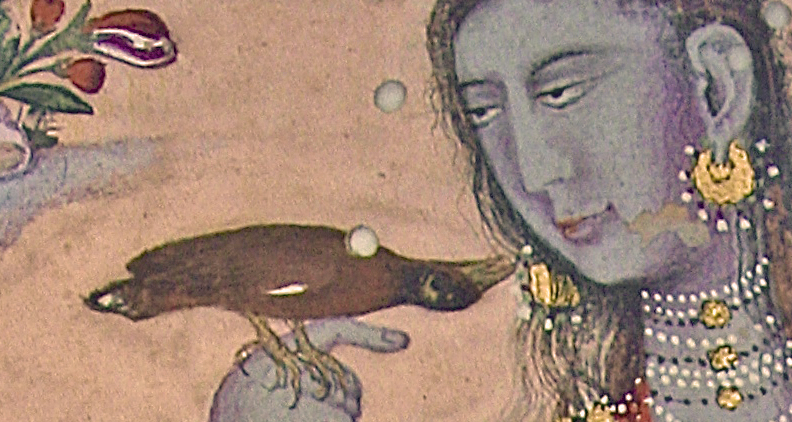
Friends called my attention to this remarkable painting Yogini with Mynah (Freer/Sackler, 1603/04, opaque watercolor and gold on paper, India Karnataka, Islamic court of Bijapur), and it prompted me to gaze at it and scrutinize it. 


The arbitrary scale in the landscape, like the overscaled plants in the middle ground, is conventional enough in a non-European work like this one; the oddity is apparent only when viewed with the perspectival perception ingrained in the Western tradition.  The detail that I find befuddling is the bird, perched on the woman’s right hand, which turns the head completely upside down, an anatomically well-nigh impossible position.  With its beak close to the mouth of the woman, the artist, we can be certain, designed it to draw the viewer’s attention to focus on the relationship between the Yogini and the bird, and we are forced to ponder on it.  

Reading a picture is a risky business.  Since the mynah, like the parrot, is a bird that “talks,” one may be tempted to to understand that the bird is conversing with the yogini, or, since the woman’s mouth is closed she may be only listening to what the bird is saying.  One interpretation, mistakenly speaks of “the lady whispering to her talking bird” (http://www.indianart.ru/eng/of_the_deccan/7.php). This writer, moreover, doubts the lady is a yogini but believes her to be possibly "Balqis, the Queen of Sheba.” Another writer reads the yogini’s gaze differently: "The mynah, perched on her arm was playfully speaking with her or maybe tugging at one of the pearls from her earrings but the yogini appeared to be in a trance, looking beyond the bird, beyond everything." (http://mariecameronstudio.com/tag/yogini-with-myna/). The yogini may SEEM to be whispering to the bird or only listening to it.  She may SEEM to be gazing or contemplating, or she may be merely gazing without seeing anything.  Then, the mynah may be talking or just listening except that a mynah, by convention, is understood to talk.  When we read a picture of a bird or any animal, we engage ourselves in an anthropomorphic projection. 

Mention of anthropomorphism may at first seem to make light of the sense of deep communication between the yogini and the bird.  But instilling a human character in any non-human creature, from mammals down to fishes is an act of COMPASSION, and it allows us to talk, say, to a fish, even, though it may not respond.  Compassion is a one-way traffic, unlike communication which assumes correspondence, that is, answering each other.  Between two individuals, on the other hand, there is never a complete comprehension.  one never fully fathom what is in the mind of her or his interlocutor from the words spoken. But understanding occurs without comprehension as described in this Zen mondō: A Zen master, taking a walk with his disciple along a pond on a beautiful day, said, “Look, how happy those fish are in the pond, ”and the disciple retorted, 'Master, you are not a fish, so you cannot really know if they are happy or not’. The Master then replied, “You are not me, so how do you know what I had in my mind when I said what I said.”  Compassion enables us to empathize and trust what was meant by what was said though ultimately we can never be sure. 

To say that a mynah or a parrot talks means that it imitates sonically the human speech.  When we humans try to imitate the sounds made by birds and beasts, our effort is onomatopoeia and it is a crude approximation, like “meow,” “oink,” and “tweet tweet.”   A mynah does not merely imitate spoken words but the pitch and tone, as well as the timbre, of the vocalized phrase it has been taught to repeat by its trainer. If we had this capacity to imitate we will learn to speak a foreign language without any accent. A child learns its mother tongue by close imitation, much closer than an adult can trying to speak a foreign language but still not as close as a mynah or parrot.  When we think a mynah is talking when it is only repeating the sound, we are acting anthropomorphically and think by compassion that we are being understood.  Seen in this light, we can consider that the Yogini is communicating with her mynah in this image, and in so understanding we are in turn reading the picture compassionately.  So, the bird, momentarily appearing supine but more likely upright, SEEMS as though it is making a tremendous effort to communicate with his yogini, and therefore the yogini in turn SEEMS as though she is contemplating without responding directly to the bird’s beckon and yet understand it compassionately.  This may be ultimately the meaning of the painting.  Reading an image is quite like reading the mind of another.   

Sunday, July 19, 2015

Workmanship and Spontaneity

An effort at originality, when less than successful, only yields a novelty. It may entertain but does little more. A work, more or less conventional, when executed with consummate workmanship, by contrast, always satisfies and delights, be it a painting, a writing, or a performance -- musical or theatrical.

A thing well-made satisfies. So does anything that shows workmanship. A beautifully crafted object elicits our affection and contemplation inasmuch as workmanship demands deliberation and patient labor. A work of spontaneity, by contrast, attracts for its appearance of immediacy and vivacity; it exudes a sense of freedom.  But it could be only a crude and sloppy thing, made thoughtlessly, even carelessly. By the same token, a well-made thing may have been worked on merely fastidiously without much thought or feeling.  

Two recent exhibitions held simultaneously at Metropolitan Museum of Art made this contrast patent: Navigating the West: George Caleb Bingham and the River and Sargent Portraits: Artists and Friends.  John Sargent’s best works thrill us with their verve and show of facility.  Bingham prepared intensely for a painting with a series of painstakingly studied drawings; at his best he impresses us with a feeling of perfection.  When less successful, Sargent is slovenly and Bingham stiff and cold. 

A work may show spontaneity but conceal thought and labor that went into its making.  After long years of experience, the artist may achieve such level of accomplishment that the work may seem slapdash but actually conceal the lifelong training and mastery distilled in its effortlessness.  Such facility is what Baldassare Castiglione termed sprezzatura in his book Il Corteggiano,  The Book of the Courtier in English translation, written in 1508-1528.  We see it most vividly in late paintings of Rembrandt; but Charles Burchfield in his late years also showed sprezzatura amply. 

Monday, February 2, 2015

Jakuchu via teamLab チームラボの若冲


Early in January I stood in front of a mural-size interactive digital work at Japan Society in New York and had me photographed.  The work, entitled United, Fragmented, Repeated, and Impermanent World, was created by teamLab, an interdisciplinary collective of technologists including computer programmers, mathematicians, architects, designers, engineers, animators, and artists, among others.  It depicts a kingdom of animals and plants and is executed in a playful palette like the illustrations in children’s books but with sound effect; and when approached to a certain distance, the image dissolves into pixels and change in configuration.  


The mural, consisting of eight panels, is adapted from the pair of six-panel screens, entitled Birds and Animals in the Flower Garden by Jakuchu Ito (1716-1800). Successful and much favored in his days, Jakuchu remained long neglected until modern times except among connoisseurs.  California collectors, Etsuko and Joe Price started to purchase his works in 1970s, and his works are widely known and is enjoying reevaluation as well as popularity, though the attribution of this particular set of screens is apparently questioned by some art historians. 


Jakuchu developed and used an innovative technique of masume-gaki or grid painting (sometimes called mosaic painting) and this no doubt caught the attention and imagination of contemporary artists in computer graphics. 


The teamLab artists observed that the advanced computer graphics can most effectively demonstrate the characteristically Japanese method of representing three-dimensional space on a flat surface without resorting to linear perspective.  The idea is actually fully demonstrated in the video version of the representation called Nirvana which can be seen on a YouTube: Nirvana- https://www.youtube.com/watch?v=8beTswbWAWM.

1月上旬のこと、ニューヨークの日本協会で、インタラクティブの壁画大デジタル絵画の前に立って、同伴のお友達に写真を撮ってもらいました。「世界は、統合されつつ、分割もされ、繰り返しつつ、いつも違う 」という題で、これはチームラボと称する斬新テクノロジストの集団の作品で、コンピュータープログラッマー、数学家、建築家、エンジニア、デザイナー、アニメーター、画家などで構成されているグループです。詳しいことは http://www.team-lab.net/all/art/ufri.html 参照。動物と植物の世界を、明るい朗らかな、子供の絵本にあるような色彩でえがいてあって、そして音響効果を伴い、ある距離に近づくと画面はピクセルに砕けて物の形も変化します。

この壁画は、八枚の画面に分かれていますけど、これは古典の改作で、原画は二對の六扉屏風「鳥獣花木図」で、江戸中期の絵師、伊藤若冲(聖徳6年ー寛政12年、1716-1800)の作品です。生存中から死後も注目を受けた絵師でしたけど、明治以降, 専門家を除いて、一般には軽視され、1970年代に至って、カリフォルニアの美術収集家の、エツコとジョー プライスが、熱心に買い上げ始めて以来、若冲の名前も作品も(私はアメリカ在住で知らなかったことですけど)突然日本で有名になったとの事。でも、この屏風の作者の真偽は、美術史家の中では疑う人もいるそうです。若冲の特殊な画法は、桝目描きと言って、画面を桝に区切って彩色する、その頃まったく斬新なやり方で、これが疑いなく、コンピュターに携わる現代の画家の注目を得る原因だったのでしょう。

西洋の遠近法を使わずに三次元の空間を平面に表す日本伝統の画法は、最新のコンピューターグラフィックによって殊に効果的に実現できるというのが、チームラボの考察です。この説明を理解するのには、同じ若冲の絵を基にしたど「Nirvana」と題した素晴らしい動画があります。Nirvana@ 伊藤若冲感性インスパイア作品展 https://www.youtube.com/watch?v=8beTswbWAWM  。