Showing posts with label Opera. Show all posts

Sunday, May 28, 2017

Opera is Art of the Voice

Opera is vocal music.  Singing creates a drama in the opera; the drama it creates should come from singing.  All too often, in modern productions, opera has been made into a sight-and-sound spectacle with singing submerged in the visual fanfare; the set, costume, and lighting, which should support the singing, too often take precedence rather than a subsidiary place.  Little wonder I experience a special excitement when I attend an opera in concert presentation; with no stage set and minimal costume and physical action, it is so much more fulfilling than a fully-staged performance, precisely because the voice with instrumental accompaniment carries the drama.  A good libretto rendered into an expressive musical composition and sung beautifully is what we get.  In some operatic works, notably in Wagner’s music dramas, symphonic music takes precedence to which voices are one additional set of instrument.  All these points were powerfully demonstrated in the recent performance I attended at Carnegie of Handel’s Ariodante featuring the English Concert and Joyce DiDonato in the title role.  It was opera par excellence superbly realized. 

05.05.17

Thursday, January 12, 2017

Mazzoli Breaks the Waves

I attended Missy Mazzoli's opera Breaking the Waves last night at the NYU Skirball Center.  It was outstanding. Everything about it was top notch: the music, the libretto, the set, the direction, the singers. 

The set, designed by Adam Rigg was a jumble of crisscrossing planks that filled a half of the stage, but it served ingeniously now as a promontory overlooking the sea, now as the oil rig, now as a hospital room; and the screen projections for different loci were very effective, too, especially the scene of the accident at the rig and the black smears that gradually filled the screens in the later scenes of the heroine’s behavioral degradation. The chorus, sometimes in black as churchmen, moved and sang menacingly, and their quick change to act the men at the rig and later as sex predators was also impressive; and the chorus members, highly individualized, registered as memorable characters.  James Darrah’s direction expertly blocked and paced the singers up and down the rickety planks. The libretto by Royce Vavrek, written in short phrases and, often repeated, were clear and easily heard.  Most of all, Mazzoli’s music was hauntingly expressive of intense and often complex emotions, dramatic at every turn.  The singers were all good, John Moore as Jan, certainly, but most of all the soprano Keira Duffy sang the difficult role beautifully; her total nudity, still shocking to some, may foretell a future, as Joyce's prose, once criminalized, no longer disturbs anyone today. 

The film by Lars von Trier tells a horrendous story about Bess, a strictly spiritual woman, who falls in love with Jan, an oilman; when he returns from an accident, totally paralyzed, she accuses herself and puts in action Jan’s order to go and have sex elsewhere, our of sheer increasing sense of guilt.  Mazzoli’s opera clarified the drama and powerfully conveyed the devastating effect on the two lovers rendered by the hypocritical church and the accident at the off-shore oil rig and ultimately the ironically twisted theme of Omnia vincit Amor.  As some critics claimed, this was certainly the best contemporary opera I had seen this year. 

Two years ago, I heard Mazzoli’s works in the Composer Portraits series at Columbia University’s Miller Theatre.  The program included the aria “His Name is John” from Breaking the Waves.  She was briefly interviewed during the program and shone in her articulate intelligence.  But the work of hers that I found especially impressive was “Death Valley Junction” from 2010, which depicted the place of that name on the border between Nevada and California, inhabited by three people, a home to eccentric Marta Beckett, “the woman who resurrected and repaired the crumbling opera house in the late 1960s and performed one-woman shows there every week until her retirement in 2012 at age 87. ”


Wednesday, August 17, 2016

Così fan tutte, Così fan tutti

Mozart’s opera Così fan tutte is one of my top favorites.  The title declares that women are fickle.  The women in the opera, Fiordiligi and Dorabella, whose fidelity is tested by their respective sworn fiancés, Guglielmo and Ferrando disguised as Albanians, succumb to seductions of the wrong man and prove their failure in fidelity.  This is, however, a male point of view.  The two men, even in playing a trickery, were exercising infidelity by seducing each other’s beloved.  From the point of view of a flirtatious woman the seducer is no less a culprit than the seduced.  The two men, even after exposing themselves, don’t realize their own folly, not to speak of Alfonso who instigated the game, while Despina, recruited by Alfonso, knows the truth that men are everywhere ready to be seduced.  Having won their proper lovers in the end, Fiordiligi and Dorabella were victorious winners.  Rightly, the whole title of the opera reads Così fan tutte, ossia La scuola degli amanti, the School for Lovers All, Men and Women, as I understand it.  I would retitle it to read Così fan tutte, Così fan tutti — They All Do It, Men and Women. Mozart’s music, of course, is unsurpassed. 

Monday, May 23, 2016

Italienisches Liederbuch

Hugo Wolf’s art songs in his Italienisches Liederbuch drew the words from anonymous Italian poems translated into German by Paul Heyse.  Translations, even when rendered beautifully, never succeeds in replicating the original; they are adaptations.  As I was listening to the first song in the set performed by a soprano, in German of course, and then reading the Italian text, I couldn’t help being struck by the drastic change of the poem’s character, in particular in the effect of the Italian diminutive suffix in “le cose piccoline” as opposed to “kleine Dinge” or even “Dingelschen.”  The case offers us a glimpse into the fundamental difference between Italian opera and German musical drama. 

Auch kleine Dinge können uns entzücken,
Auch kleine Dinge können teuer sein.
Bedenkt, wie gern wir uns mit Perlen schmücken;
Sie werden schwer bezahlt und sind nur klein.
Bedenkt, wie klein ist die Olivenfrucht,
Und wird um ihre Güte doch gesucht.
Denkt an die Rose nur, wie klein sie ist,
Und duftet doch so lieblich, wie ihr wißt.

Le cose piccoline son pur belle!
Le cose piccoline son pur care!
Ponete mente come son le perle:
son piccoline, e si fanno pagare.
Ponete mente come l'è l'uliva:
l'è piccolina, e di buon frutto mena.
Ponete mente come l'è la rosa:
l'è piccolina, e l'è tanto odorosa.


The Italian text is available in Canti popolari toscani, corsi, illirici, greci, raccolti ed illustrati da Niccolò Tommaseo, Venezia, G. Tasso, 1841. 

Tuesday, November 17, 2015

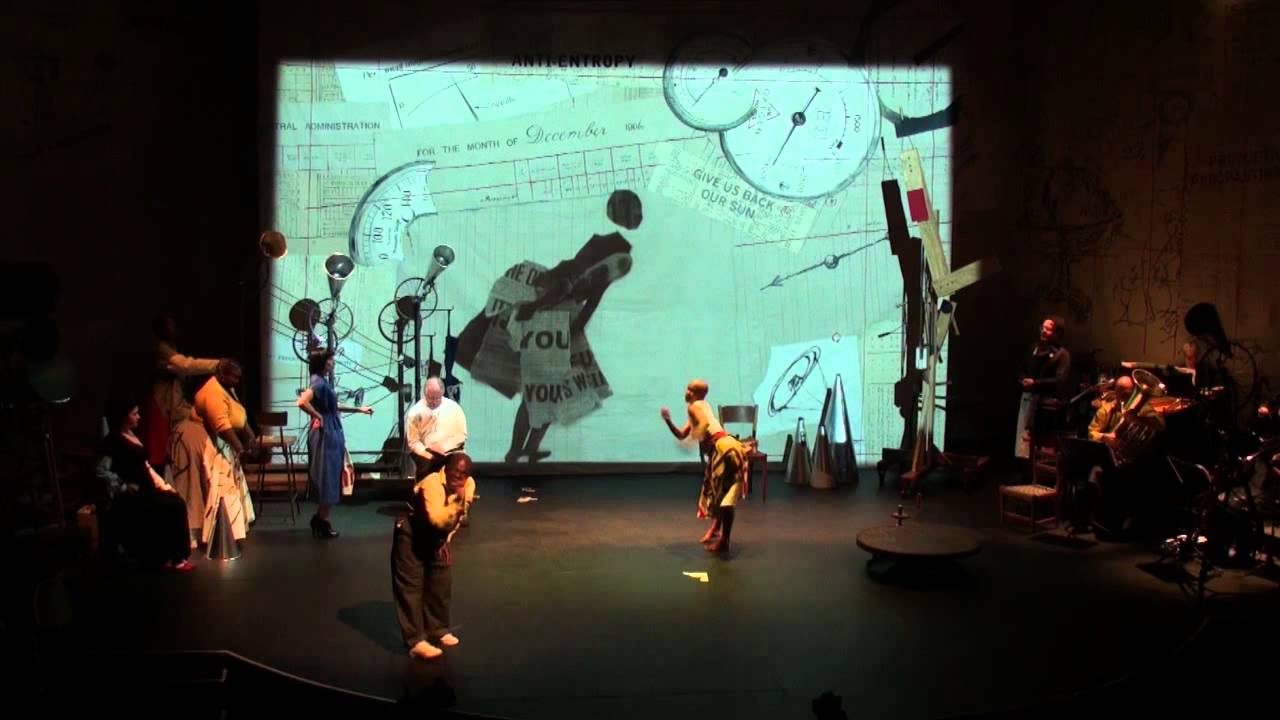
Kentridge Masters Lulu


The opera Lulu at the Met in its new production by William Kentridge was an exuberant spectacle, dominantly his than of its composer Alban Berg.  Despite Marlis Petersen’s superb performance in the title role, both in singing and acting, and the powerful music under the direction of Lothat Koenigs replacing indisposed James Levine, what remained in memory was the dynamic stage display of Kentridge’s design, rapidly and incessantly changing sets composed of fragmented flats, video images, placards, masks, and the brushed drawings in process coming out of Kentridge’s own hands.  The belief underlying the production, no doubt, is opera as Gesamtkunstwerk as conceived by Richard Wagner.  I contend nonetheless that what distinguishes opera from other forms of music theater is singing to which other artistic endeavors are certainly not to be subservient but stay eager participants.  Kentridge’s so-called chamber opera at BAM earlier, Refuse the Hour, was this artist’s similarly dense multimedia spectacle but it succeeded totally because he was his own ringmaster.


It dealt with a complex idea of time, temporarity, and memory, resulting from his consultation and collaboration with the physicist Peter Galison, and the ensemble of dance, music, and singing performed on stage and the remote-controlled set of drums suspended from the loft, and Kentridge’s own sketches and collages and film clips, together with his recitation of the libretto text he wrote, worked dramatically together to expose the mystery of time — time arrested, reversed, accelerated, decelerated, elasticized, fragmented, and otherwise distorted.

But the spectacle similarly overlaid and orchestrated was just too much for an opera production, domineering our attention excessively.  Kentridge also introduced two extraneous non-singing characters, non-singing, therefore, additional visual distractions, a butler character who flittered across the stage every so often and a young woman, nominally a pianist, who sprawled on the piano most of the time and occasionally making choreographed poses.  What I found sorely missing is the clearly defined mise-en-scene for the three acts, set successively in Vienna, Paris, and London, marking Lulu’s progressive degradation.  After several viewings, with the visual novelty wearing out, we may learn to pay less attention to the stage and concentrate on the music and singing.  But I suspect it will take more than a few years of repeat performance.  William Kentridge is a great artist, visionary and inventive in his conceit, broad and profound in his socio-political perspectives, and most adroit in realizing them.  His work on Shostakovich’s opera The Nose was admirable no less than his earlier efforts Il ritorno d’Ulisse and Die Zauberflöte. It is a pity that there was no one to restrain him in this latest effort.  

Wednesday, February 4, 2015

Lady Macbeth of Mtsensk


On 7 November last year (2014), I attended the dress rehearsal of Lady Macbeth of Mtsensk, the opera by Dmitrii Shostakovich, at Metropolitan Opera.  Eva-Maria Westbroek, a Dutch soprano, who performed Anthony Turnage’s Anna Nicole earlier, sang the title Katerina role dramatically.  At the end of the first scene, following her lament on her neglectful husband Zinovy, he leaves to attend the repairs at the dam site he was overseeing.  In this production by Graham Vick, a car is parked in the garage, stage right, and he gets in the driving seat but it didn’t start.  So, helped by his father Boris, he pushed it off stage.  I thought the car out of commission was a perfect metaphor for the ineffectual husband, though I was not sure if it was a detail in the direction or a snag in the staging.  When I returned to the Met on 17 December for the real performance, alas, the car started right away and he slowly drove out off stage.  Sometimes, a slip can trigger a creative decision as in Balanchine’s Serenade a ballerina who arrived late for rehearsal and another who fell on exit with the corps were incorporated in his finished choreography. 

In Act III (shown above), a large sign in Cyrillic alphabet — adorns the scene overhead.  It reads поздравляем; I was curious about it and figured it out that it said “We congratulate,” rather than Поздравление/Поздравления (Congratulation/Congratulations).   

The opera, composed in 1934, was based on the 1864 story of the same title by Nikolai Leskov (1831-1895), a contemporary of Tolstoy, Dostoevsky, and Tchaikovsky, much celebrated there but less known here until recently.  I read the story in two translations, one by David McDuff and a newer one by Richard Pevear and Larissa Volonkhonsky.  The latter was particularly impressive for the fluid and expressive narrative, notable in the way the rhythm of the prose replicated that of the action portrayed in the manner of ekphrasis — leisurely and relaxed in the scene of romance and terse and brisk in depicting quickly executed murders.  It was instructive to compare the story with the opera’s libretto, which obviously selected and highlighted certain more sensational events. I was confirmed anew that the opera, in contrast to the prose which flows like a river, is a loosely joined sequence of firework as it should be to succeed.  Shostakovich and Alexander Preis, who wrote the libretto understood this well. 

A month later, at BAM, I saw the opera The Enchanted Wanderer, another adaptation of a Leskov story, composed by Rodion Shchedrin; he also was the librettist.  Here, curiously, Leskov’s story was drained of the adventures that would have served the opera well, and was developed as a staged oratorio — so strikingly unoperatic though exciting enough musically.  

Thursday, January 3, 2013

Il Barbiere into The Barber

The Barber of Seville, sung in English, which the Met proudly mounted this season, not surprisingly deflated Gioachino Rossini’s sprightly opera, Il Barbiere di Siviglia. The problem was the English language.  Every language has its own cadence, and, to the extent Rossini matched his music to the rhythm and flow of the Italian language in Cesare Sterbini’s libretto, the English translation, despite J. D. McClatchy’s effort, brought out blatantly the discord between the language and the music.  This is not to say that Italian libretti cannot be successfully translated.  It just so happens that the clarity of vowels, essential in an opera buffa, in particular in those patter passages, are hard to come by in English which is rich, instead, in slurs and schwas (those unstressed vowels).  The contrast is evident in the very word in the title; il barbiere, pronounced in five crisp syllables (il-bar-bi-e-re) comes out as the barber, pronounced in three syllables of a schwa-slur-schwa.  Note how the word like padre becomes fluffy in father and qui e la comes out drawn out in here an’ there; and gioia e pace peters out sonically in joy and peace.   English words more frequently end in a consonant whereas Italian words almost invariably end in a full vowel.  It’s not that for these reasons English is not suited to the opera.  Purcell, Gilbert and Sullivan, and Britten glorified their language in their operatic works; Cole Porter and Stephen Sondheim wrote lyrics and music to fit the English cadence.  Though the English Barber, abridged to two hour from the three-hour long Barbiere, was trumpeted to be a family fare for the Holidays to suit the kids in the audience, we must recognize that children are often more responsive to the comic effect of nonsense words and, therefore, to the succession of brisk syllables the Italian Barbiere delivers with gusto. They grasp the sense of the sung phrases if they failed to understand their word-by-word meaning.  The Barber sounded flat like the birra that lost its fizz; it was un barbaro di Siviglia.
 

Friday, November 16, 2012

Met's new Un Ballo in Maschera

The opera was sung beautifully by a super cast -- dramatic Radvanovsky as Amelia, thoughtful Hvorostovsky as Renato, weighty Alvarez as the king Riccardo, and sprighlty Kathleen Kim as Oscar, thoroughly Verdian; but David Alden's updating was silly with a sterile abstract set offset by a mural-size Rubenesque Fall of Icarus -- all quite pointless -- and a comical costuming and choreography to boot.The painting is splendid, nonetheless.

Saturday, November 3, 2012

The Tempest not so Tempestuous

The opera The Tempest by Thomas Adès, first performed in 2004 in London and now at the Met, was boring and disappointing, or, to put it mildly, unappealing to my taste.  I didn’t think there was much of Shakespeare’s drama in it.  First of all, the Bard’s lines were almost totally lost in the librettist Meredith Oakes rewriting, supposedly for improving them for easier singing. But, then, more seriously, the words sung could hardly be heard, the music, itself eclectic with little character of its own, failed or made no effort to support the words and capture the unique cadence of the English language, what Henry Purcell 300 years ago and Benjamin Britten more recently excelled in, granted that in the case of Ariel, Audry Luna’s high-pitched coloratura, if one can call it that, the inaudibility of words made some sense.  Most outrageously, however, Robert Lepage, an eager beaver for a novelty at any cost, made Prospero into an impresario of the mockup Scala, a conceit hard to imagine more conceited. There were some fine moments, as any less successful work is privileged to have.  The opening scene of the storm at sea, a projection of waves on a sheet with slits to accommodate bobbing figures, with a stormy dissonant music on the orchestra, was very effective.  The duet of Miranda and Ferdinand at the end of Act II was full of lyricism, though the backdrop of the sunset beyond the calm sea toward which the couple walk away, was a cheap Hollywood scene.  Simon Keenlyside, as expected, sang beautifully throughout; and Alan Oke’s Caliban was superb musically and theatrically. Verdi didn’t retain Shakespeare’s words because he used the libretto in Italian, and yet he captured the spirit of Shakespeare’s drama in Otello, Falstaff, and even Macbeth, and Britten illuminated the Bard’s poetry in his version of A Midsummer Night’s Dream.  “Inspired, audacious, and personal,” wrote Anthony Tommasini; he may be right. More Adès and Lepage than Shakespeare, I’d say less than happily.

Friday, October 26, 2012

Il Trovatore 2012

I heard Il Tovatore last night at the Mett. It delivered passion as an Italian opera, especially Verdi, always should but doesn’t.  Guanqun Yu, a Chinese soprano most of us have never heard or even heard of before, sang Leonora, and she set the tone.  From the very fist appearance in the palace garden, singing “Tacea la notte placida,” her voice rang commandingly.  It was not only beautiful in itself and beautifully modulated, but it was also deeply felt, and she got better and better, especially in duets.  The excitement was all the greater since it was a new voice.  Two male leads, Vassallo as Il Conte di Luna and Gwyn Hughes-Jones as Manrico were good too.  It is perhaps in relation to Leonora’s passion that Dolora Zajick's Azucena was somewhat toned down in the effect of horror in her recounting of the burning stake.  I recall I was more moved by Giulietta Simionato and Fiorenza Cossotto.  I hope to catch Stephanie Blythe as Azucena later in the season.  I like this David McVicar production and the set by Charles Edwards featuring over fifty steep, narrow steps along a wall.  I always worry if Ferrando will safely come down and up again.  Morris Robinson, despite his weight, made some 30 steps back up to the landing quite nimbly.  It is a versatile set that, revolving, makes different scenes.

Friday, April 6, 2012

The Ring Cycle

The Ring lost and found
Wagner’s gods rage until dawn --
Ravish us to death.

Tuesday, January 24, 2012

Pastiche "Island"

Last Saturday, I heard on the radio the broadcast of The Enchanted Island from the MET. Having complained about the visual excess of its stage production, I anticipated a better musical integration. It was pleasanter, no doubt, to hear a program of Baroque music, but without the spectacle to distract, the musical pastiche showed seams, apparent even to my inexpert ear. I was hearing Handel and suddenly it was not Handel. True, Baroque composers, including Handel, practiced pastiche but as with Rossini later, he pieced together segments of his own compositions and if he used those of other composers he most likely made them his own. A pastiche by a third party is a different kettle of fish, more like a potluck supper, sumptuous but without a signature. Without a single commanding hand, seams may be smoothed out but they still show.

Thursday, January 5, 2012

The Enchanted Island

The Enchanted Island, the new pastiche opera at the Met, was striking, gorgeous, magnificent, totally enchanting, indeed, over the top. . . as a pastiche. But a pastiche it was, though the pieces were well put together, musically and theatrically, by the masterful hands of Jeremy Sams, with no unsightly seams in sight. Moreover, the production featured a parade of topnotch singers -- awesome David Daniels, powerful and beautiful Joyce DiDonato and Danielle De Niese, venerable Placido Domingo, and other impressive talents, and peerless William Christie directing. The use of the video projection of the 59 Productions was truly magical; and the lavish set and costume design was dazzling. The music drawn from Handel, Vivaldi, and Rameau, among others, was interminably a delight. Yet. . .and yet . . . it was a fragile contraption, a fairground festivity, a bouquet of tissue paper flowers, marvelous fireworks. It had little substance and got boring after the initial uplift; it was a marvel while it lasted but left very little after it was over.

Given all the splendor, it took me a while to determine the fundamental flaw, and I diagnosed it to be the excess of visual opulence. I’m no purist, and I understand pastiche as a legitimate creative style in the 18th century. and fantasy as a promising artistic form; and I know well that Baroque in art aspired for the splendiferous, even the stupendiferous. But the stage spectacle was overwrought to the point it was no longer an opera but a circus show at the expense of everything else -- the orchestra and, most of all, the contribution of beautiful singing talents. There was already an excess in wedding Shakespeare’s The Tempest and A Midsummer Night’s Dream; the effort undermined the depth of both plays and made us long for one or the other in its integrity. Ariel doubling as Puck is fun but no more than that. A show so rich and so cheap! A Baroque opera of more credible splendor was demonstrated by Lully’s Atys performed at BAM last September under the direction of the same William Christie -- a recreation of the 1987 production at Opéra Comique, Paris. No doubt The Enchanted Island was a great show, a masterpiece of its ringmaster, Peter Gelb. But if he thinks this project, surely costing a fortune, is going to create future opera fans, he might think twice because, most likely, any opera novice returning to the Met after this razzle-dazzle enchantment will only see any true opera pale as a spectacle and most likely disenchanting.

Wednesday, August 17, 2011

Iván Fischer's Don Giovanni

Less is more is apparently Iván Fischer’s creed and he demonstrated it admirably in his Don Giovanni (Prague version, 1787), in a staged concert as a part of the Mostly Mozart Festival, for which he directed the singers and conducted the orchestra. The production had the singers lightly costumed in street clothes with no sets and props but with sixteen young actors, recruited from the Budapest Acting Academy, all sprayed ashen gray from the top of the head to the tip of the limbs to look like statues who arranged themselves on the stage singly and in groups. Through the opera they rearranged themselves to suit the production needs, serving as a set (for example the window where Elvira appears), a prop (for example the banquet table to which the Commendatore is invited, and as the chorus (for example, in the ballroom scene where some members of the orchestra appear on stage as musicians). Without sets and props, the orchestra and the singers were duly foregrounded to good effect, Don Giovanni, discovered by the Commendatore, instead of injuring him in a duel, pushes a statue group over him; and the “living” statues close in on Don Giovanni at the finale and devour him with much more horrific effect than the the hell fire. Fischer conducted the Budapest Festival Orchestra and the cast of fine singers somewhat with more brawn than grace and this made Don Giovanni more a villain than a playboy and his accusers more ferocious, all for a more vigorous drama. Fischer teaches us that so much can be accomplished with a fraction of the cost of the spectacular full productions, so dear to the Met and yet too often so self-defeating however grand they may be.

Friday, January 21, 2011

Willy Decker's La Traviata

The stark iconoclastic production of Verdi’s La Traviata by Willy Decker, inaugurated this season at the Met, is inevitably a shock to the audience long seeped in the version set in Dumas’ 19th-century Paris. But approached with an open mind, it does free the opera from the burden of the spectacle and foregrounds the music and the stage action effectively reminiscent of some of Wieland Wagner’s productions of the Ring. Decker in an interview explains (not very convincingly) that the circular wall and the clock in the set design, alluding to the cycle of passing of time, were suggested by the overture playing the theme of Violetta’s death scene. But through the three Acts there are some inspired conceits that are worthy of note. The surging figures at the party, all in black, in Act I, overpowering in their choreographed movements across the stage, registered vividly the social isolation of Violetta, alone in red. The random placement of five sofas covered with homely floral chintz (with the matching robes of Alfredo and Violetta) captured the casual rustic life style without a country house set; and Violetta’s stripping the covers during her interaction with Germont was terribly expressive of her condition of being robbed bare of her happy life and made the "Addio" duet very touching. In the scene of the masked ball, the clock was ingeniously turned into a roulette table; Flora, who hosted the party, wearing a black suit, was lost in the crowd In the final Act, the Carnival, heard outside the window traditionally, rushed onto the stage obtrusively; but the tapes left strewn on the floor looked like streaks of consumptive blood. The death scene without a bed made the final scene less affective than usual. The figure of Dr. Granvil, appearing hauntingly through the three acts made sense emblematically only if we accepted the director’s reinterpretation of Violetta as a victim of inexorable time. It rather turned La Traviata in Paris Nordic.

Saturday, August 7, 2010

Ravishing Wagner

It occurred to me this morning that the two words, ravish and rape are cognates, both derived from the Latin rapere, to seize.

To rape is to seize by force and violate a woman; horrendous as it is, a woman raped, obviously from the male point of view, is ravished -- rapt, enraptured, even raptured, which means transported from earth to heaven, all derived from rapere. A similar dichotomy exists in capture and captivate.

This gave me an insight into Wagner’s operas. All my life, I hated Wagner. To avid Wagnerians such a statement is a sacrilege. I’ll be more reasonable and say that I have always held a strong resistance to Wagner. It is a matter of personal taste; but, on the other hand, it is a taste shared by my friends who think of the paradigm of the opera as Italian, where the beauty of the human voice is venerated for what it is by isolating the singing and framing it in the form of arias. For Wagner, on the other hand, the voice is only one of the symphonic instruments, submerged in the gushing torrent of sound.

I find Wagner self-indulgent to the extreme and his operas overwrought and unbearably domineering. I made efforts nonetheless and attended the Ring Cycle and most other works at the Met and elsewhere at least once, and I listen them on CD. As I write this, the radio is broadcasting Siegfried, a production of the LA Opera, the most overbearing of the four that make up the Ring, and listening to it symphonically without the burden of the dense mythology-invested theatricality, I am finding the music, woe to me, ravishing.

I had for some time, regarding Wagner’s opera, another notion -- that it is a kind of art that perhaps holds a special appeal to the masculine appetite for power in us, both women and men, but particularly the latter. His operatic creations are, above all, grander than grand -- grandiose; they require a colossal orchestra, superhuman voices, and long hours to perform. So, they exude an overpowering sense of power; if you are willing to submit yourself to them, they are empowering. Wagnerians find them awesome -- almost like a seismic catastrophe, a great conflagration, a volcanic eruption, a super-Godzilla -- and intoxicating; they delight in being transported into ecstasy, the state of being ravished.

Wagner means to ravish us. He takes hold of us and means to exercise a total control of us -- our intellect and our emotion. Every great work of art, to think of it, transports us to a higher level of consciousness. To those of us who resist Wagner, his force is coercive, perhaps dictatorial. He ravishes us whether we want to be ravished or not. The problem, I confess, is mine.

Friday, January 22, 2010

Carmen - Garanca/Alagna

Hot flames but no spark. This was my impression of the
Carmen at the Met last night, featuring Elina Garanca
and Roberto Alagna, both of whom sang passionately. But,
curiously, they didn't collide. My heart didn't palpitate.

Thursday, January 21, 2010

Puccini's 東天紅

I was at the Met to listen to Puccini's Turandot. All my life I thought he used Japanese and Chinese tunes indiscriminately in it. But I wondered about it. I knew that he took the tunes from the music box that belonged to a diplomat who spent years in China. So, finally, I looked into the matter on my return home. The boys' chorus in Act One sings "Là sui monti dell'Est la cicogna cantò," (On the mountaintop in the East a stork sang). On a Japanese website I learned that this <東天紅>(Crimson Eastern Sky) derives from the <茉莉花>(Mo Li Hua/まつりか/Jasmine Flower) and the tune was already known in Japan early in the 19th century and subsequently well acclimatized in Japan and therefore sounds Japanese to the Japanese ear, like <やーまのおてらのかねがなる> from <夕焼け>. Hmm.