Showing posts with label Ballet/Dance. Show all posts

Saturday, February 11, 2017

Thoughts on Dance

I have been going to dance performances, both ballet and modern dance, and also everything else, quite regularly and frequently now over 15 years, and with still a great deal I am trying to understand, I have some thoughts I wanted to write down.  

Dance is an art form which uses the human body in sequences of postures and movements.  

To the extent that the bodily movements are almost inevitably gestural, it is conversely nearly impossible to strip a dance movement of mimetic expressions.  An arm raised may beckon, yearn, spurn, menace, explore, or hope, as the case may be; the expression is varied and made more specific in combination with the turn of the shoulders, neck, elbow, wrist, hand, and fingers, not to speak of the legs, the torso, and the rest of the body.  Every part of the body, singly or in combination, expresses a purposeful action by default, allowing the dancer infinite possibilities of expression.  Conversely, then, to choreograph a dance that is non-representational is nary impossible.  

Still there are dance forms that can be seen as movements for the sake of movement.  Tap and Irish step dance come to mind; but as with many forms of folk dancing, they do express joy of movement contagiously.  So, when a child spontaneously starts to jump up and down and twirl round and round, it is expressive of joy.  A temper tantrum is perhaps a form of dance, if lacking in rhythmic control. 

George Balanchine, who rejected the description of his work as abstract, rightly pointed out that if you put a ballerina with a male partner on stage, you have a story.  His more abstract dances are best described as plotless, in contrast to the classical story ballet; but they are still figurative.  The works of Jerome Robbins, Martha Graham, and Mark Morris, are all by and large overtly mimetic. 

The works of Merce Cunningham, as with the music of John Cage, with whom he closely collaborated, is perhaps noteworthy for their abstraction, dance as dance, in some of the works he choreographed.  He invented postures that made it difficult to be read as gestural.  John Jaspers in a conversation spoke of the “value of embodied knowledge” last fall at BAM; in my mind I paraphrased the statement as “the celebration of non-verbal communication,” that is to say, making the body speak in place of words, of events, memory, and knowledge.  Dance, in short, uses the body as an expressive vehicle of emotion and meaning, without words but still inevitably with mimetic imagery.  Many choreographers in modern dance seem intent on achieving “pure” dance by abstracting the movements.  Totally purged of imagery, bodily movements become gymnastic; there is much to be admired in the dynamism per se, such as speed, strength, energy and endurance, as well as the postural complexity and the geometry of the ensemble dancing.  It may be left to the audience to read into the abstract movements whatever expression it chooses.  But, of course, there is always music that defines the meaning intended. 

Analogy exists in abstract expressionism, as of Jackson Pollock, Franz Kline, Pierre Soulages, and Helen Frankenthaler, in whose works expression consists of shapes, colors, and, above all, gestures as traces.  They are non-figurative but mimetic, albeit minimally.  The works of Agnes Martin strike me as totally non-mimetic and yet expressive. The artist explained herself:  
When I think of art I think of beauty. Beauty is the mystery 
of life. It is not in the eye it is in the mind. In our minds there 
is awareness of perfection.
The ideal expressed in this statement and in her magnificent paintings finds its counterpart in the best of Balanchine’s more abstract dances.  The movements may not be entirely free of mimetic suggestions but don’t insist on them; they may be abstract but not devoid of emotion.  But, above all, the dancers’ efforts are persistently directed toward the expression of beauty embodied in the lines as stipulated by the Classic Ballet. What Balanchine achieves at his best is poetry.

Cunningham, pushing further into the realm of abstraction, similarly achieves poetry by directing the dancers’ movements away from sheer athleticism toward expression of a certain difficult-to-define yet unmistakable ideal beyond physicality, perhaps even more like Agnes Martin.

With my thoughts on dance I am explaining to myself why, for me, Cunningham and Balanchine stand at the acme of achievement in dance.

Monday, January 16, 2017

Study on Effort

Study on Effort performed at the Invisible Dog Art Center in Brooklyn by Bobbi Jene Smith, a dancer out of The Batsheba, and violinist Keir GoGwilt, does not actively try to entertain.  As the ingenious title insists, it tries to involve the audience to experience immersively the reality of the hard work that making any art is, in this case dance and music.  Failing to understand this premise, the audience may be misled to read the dancer’s nudity as a titillation.  

The opening sequence immediately realizes the theme of effort as the nude dancer makes slow, tortured movements, accompanied by the drone of James Tenney on the violin as its player makes an equally slow ambulation around the periphery of the low stage surrounded by the audience on three sides.  The spectator/listener is invited to follow the work with as much effort as the nude body which lays bare all the strained muscles and the violin which tireless repeats barely changing phrases over and over.  

This overture is followed by four sections which are variations on the theme, four contrasting exercises, some frantically fast and energized, others slow again as in the act of hauling sandbags.  The musical selections marking the sections are distinctly contrasted; they include an Improvisation by GoGwilt himself and Sarabande from  J. S. Bach’s Partita No.1. The dance and the music mesh effectively by mutually reinforcing the theme, now in counterpoint and now in unison. Smith’s effort receives magnification from the violin, and the music, which by itself would be absorbed by the listener more passively, becomes muscular in combination with the dance’s physicality and forces itself on as hard work; and the audience in its effort becomes active participants in the making of this effortful art, at once visually and aurally.  The change in the character of art from section to section gave us a welcome respite for performers and the audience alike.  

The audience at the Invisible Dog was too large and diminished the impact the performance would have given amidst a smaller audience, preferably on two sides of the stage prompting a more concentrated focus on the happening.  

Saturday, September 19, 2015

Rice and Tree: Two Dances

The dance performance Rice by the Cloud Gate Dance Theatre of Taiwan at BAM Gilman Opera House was very exciting.  It far surpassed my expectations.  So far I saw the company twice before this one: Wild Cursive and Water Stains on the Wall, and I heard Lin Hwai-min, the choreographer, twice in a pre-performance talk, the first time with Anne Kisselgoff interviewing him.  We saw in Rice the same varied body movements that are uniquely his and the highly sophisticated ensemble dancing, complex and yet never confusing.  In addition, the cycle of the rice cultivation through the changing conditions of wind, sun, and rain, beautifully projected on the large background screen with moving soundscape, gave the dance, aptly integrated with the sound and images, a fine sense of thematic cohesion. The folksongs in an old Chinese dialect provided more poetry to the piece.  So, the choreography was excellent, now dynamic and now poetically restrained, now fast and now slow; the dancers equally excelled in their vigor and precision; and the costumes, simple but with carefully coordinated palette, added a flair, all very impressive and satisfying.  

Two days later, I saw Tree of Codes, a production at the Park Avenue Armory, a spectacle by Wayne McGregor choreographer, Olafur Eliasson light designer, and Jamie xx composer, inspired by the book of the same title by Janathan Safran Foer.  Despite the grand scale of the work, it was sorely disappointing.  It lacked any sense of integration between Eliasson’s lighting, itself gimmicky with no coherence, and McGregor’s choreography, itself vigorously athletic but repetitive with no running theme of any sort nor expressive impact and thus boring.  There was some magic in the frontal glass surface serving at once as a reflective mirror and the see-through surface foreground glass wall serving at once as a reflective mirror and the see-through surface.  During the very first scene where the dancers were rigged with lights schematically outlining the dancers, I was thinking that what makes a dance wonderful in live performance is the human body, here concealed; then, in the next scene we saw simulated naked bodies, and they made me think how costumes amplify the bodies in motion.  The play of light for the rest was entirely arbitrary, like a child playing with a flashlight.  It was a striking contrast to the poetically illuminating dance by Cloud Gate. 

Saturday, May 3, 2014

Dance, no Dance

When a dance is overly mimetic it becomes a pantomime; when it goes too far in athleticism it becomes a gymnastic show. They are fine for what they are but I expect a dance to be what it is, that is, mimetic and/or athletic to a degree but significant beyond the surface and, above all, graceful — individually or collectively. Movement may be slow, as in the Japanese Noh, and it is still dance; but beyond a certain limit, absence of movement turns the dance into a tableau-vivant or an installation.

Sunday, February 2, 2014

Dance on Film is Dance Film

Dance on film is not dance.  By this I mean that a dance on film is a film, and it is substantially and experientially different from the dance performance it recorded, even if substantively analogous to it.   In saying this, I am not denigrating the genre; it has a legitimate existence, not only for its archival function of preserving a fleeting performance, but also on its own merit as an artistic form.  

I attended recently a program of twelve short dance films; some of these films recorded dancers dancing; others were film essays that happened to deal thematically one way or another with dancers or dancing, or else with characters who danced or events that included dance. The interest in all these films, regardless of quality, was the work as film, not as dance.

The distinction between dance on film and dance on stage (or in the open) is easily lost in this age in which we experience the world overwhelmingly through film, television, and digital media.  I am no exception, for that matter, since it was my interest in dance that drew me to see these dance films.  Still, the distinction is of paramount importance.  A photograph is not the same as the painting it reproduces, however faithfully; it may present the subject and the general composition but fails to capture the palette, brushwork, and subtle details that distinguish the work.  This can be said of photographs of any kind, too, which lose the surface quality when photographically reproduced in published books.  This can be said, indeed, of photographs in relation to the real visual world; they are always selective and reproduce reality only so far.  The distance between the work and the reality is even larger with documentary films; they may represent a scene or event but do not reproduced it.  It is the witness role of the camera that misleads us.  The camera was there to capture the scene, yes, but it also transformed it.  As with dance, opera on the screen is a genre in its own right and should not be thought as another variant production.  There is no question that it has its precious purpose of providing something of the experience of the opera to those without access to live opera performances.  But it is a misguided notion to assume that one has experienced an opera without having seen and heard it performed on stage.

The problem extends to stages plays in general, of course, but especially with Shakespeare’s plays.  I consider it preposterous to think one knows a particular Shakespeare play only on the basis of the filmed version as it is on the basis of the written text studied as literature. 

I even extend my view of the primacy of visual and aural experience to live music performances as I wrote earlier in Looking while Listening. On further thought, I observe that a public lecture heard and viewed as a talking head on TV or video may be substantially the same lecture as the one experienced live in an auditorium but lacks the totality as an experience, which accounts for the full and vivid reality that in the first attracted its willing audience.

One of the best dance films I have seen recently is David Fishel’s Hästdans på Hovdala, which documented the rehearsal process of the outdoor dance performance choreographed by JoAnna Mendl Shaw of The Equus Projects (which combine dance with equestrian artistry), which in this instance also involved young people of autism.  It dealt with the making of a dance as the subject and showed clips of the finished dance performance only perfunctorily at the  conclusion of the film.  Shaw’s choreography, as captured on film, is superb; but it is first and foremost an excellent film.

Friday, October 4, 2013

Dance and Dancers

Down below we watch the dancers; high above we watch the dance. Attending the New York City Ballet at the NY State Theater, I normally sit in the Second Ring; I enjoy the synoptic view. The other day, I sat with a friend in the second row of the orchestra, and realized this.  At the Met Opera, my seat is Center Balcony for the good mix of sight and sound.  For symphonic music at Avery Fisher, I sit in the first row of the Third Tier for the total sonic effect; for chamber music at Alice Tully I am down in the orchestra half way up from the stage to enjoy the sight of the musicians.
 

Tuesday, November 6, 2012

Pina's Swan Song

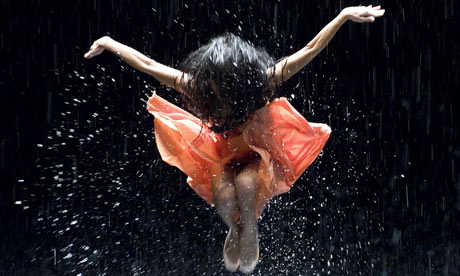
Pina Bausch’s Tanztheater Wuppertal came to BAM in mid-October to perform her final work three years after her passing in 2009. I know her at least three later works by this doyenne of the dance world since 1973, all very memorable: Für die Kinder von gestern, heute, und morgen, 2002 (BAM 2004), Nefés, 2003 (BAM 2006), and Vollmond (Full Moon), 2006 (BAM 2010).  The latest, awkwardly titled “. . .como el musguito en la piedra, ay si, si, si. . . (like moss on a stone)” certainly does not measure up to them.  On 12 June, it had its premiere in Germany, five days after she was diagnosed with cancer, which took her life three weeks later on 30 June. This circumstance may explain the lack of dynamic energy, at times almost fearful, that we find in her major works.  Like her other works, the work is shaped like a vaudeville show, dance pieces alternating with laughter-provoking skits, literally a combination of “Tanz” and “Theater” in the name of the company.  The absence of a narrative arc, without noticeably strong pieces in the middle to engage the audience, necessarily gives the impression that the work is a bit repetitive and flat and too long. But in the often surrealistic skits, like the first scene in which a woman on all fours is lifted stiff like a table by male dancers as she yelps like a dog, and, even more, in the lively choreography, we find Pina’s hallmark, which I enjoyed not just nostalgically but in itself.  Female dancers wore familiar elegant evening dresses of vibrant colors, down to the ankles, and they dashed and leapt, their long luxuriant hair, now flying away every whichever way, now twisted and tangled around with fingers, with such exuberance as no dancers elsewhere ever match in doing, and their ensemble movements dazzle us in speed and complexity.  They are mesmerizing.  The piece ended by repeating some scenes that opened it, as though it ran out of breath as of ideas.  Melancholy pervaded as it closed not with a bang but a whimper. 

Monday, January 2, 2012

Wenders' Pina


I went to see Wim Wenders’ new film Pina 3D, a documentary on the choreographer Pina Bausch and her Wuppeltal Tanztheater. The film as film is undistinguished, and the 3D technology added little to the power of her dances for those familiar with them in live theater. Still, the filmmaker’s ingenuity in piecing together a work from a project frustrated by Bausch’s sudden death in 2009 is admirable, combining dance footages with the dancers’ testimonials most effectively shown rather than spoken [that is, only as voice-over statements as though we are listening to their inner thoughts].

I have seen the Wuppertal performances in four programs: Für Kinder von gestern, heute und morgen (2004), Nefés (2006), Bamboo Blues (2008), and Vollmond (2010). Bausch’s dances are intensely dramatic; and they are drawn from a wide range of global sources. She is quoted as saying that she is “not interested in how people move but in what moves them.” If I were to give a single-word characterization, Bausch’s choreography is fury in contradistinction to Balanchine’s elegance, Robbins’ everyday, Mark Morris’ joyfulness, and Cunningham’s cosmic geometry. [Yes, Merce gets an extra word.]

Tuesday, December 13, 2011

Merce Cunningham Legacy

I attended three consecutive evenings of Merce Cunningham: The Legacy Tour at BAM last week, the final performances by the company.

The choreographer’s six seminal works, among many, were performed -- three works before 1990 (RainForest 1968, Second Hand 1970, and Roaratorio 1983) and three later works (Pond Way 1998, Biped 1999, and Split Sides 2003). I saw another Legacy performance earlier this year in March at Joyce Theater; this included Antic Meet 1958, Quartet 1982, and CRWDSPCR 1993. Then, in July, at Merce Fair held at Lincoln Center, I saw Squaregame 1976 and Duets 1980. I have been to many Merce events, too, before his death on 26 July 2009 at 90.

Three days of immersion in Cunningham’s choreography brought me some (to me) new and more clarifying observations.

First, his dancers in his dances, in particular in his later works, are noteworthy in avoiding facial expressions and histrionic or even mimetic gesticulations. Their movements are therefore emphatically graphic, created as geometric configurations; his dances are totally non-mimetic and strictly abstract in this sense.

Secondly, in contrast to the works of many other choreographers, Cunningham’s dances are geometrically fully three-dimensional in conception. Dancers, of course, occupy a three-dimensional space and they do move sideways as well as in depth and in diagonal directions. But there is more often in other choreographers works a feel for the audience on one side -- outside the proscenium arch or the fourth wall. Cunningham makes us learn to see his dance group configurations in a fully abstract space without any walls. It is little wonder that he choreographed some of his dances in an open outdoor space. On the other hand, he is sparse in the use of vertical movements -- jumps and leaps.

Thirdly, Cunningham’s dancers, even in leotards or minimal covering, do not exhibit their bodies in their sensuality. Human bodies as bodies do not seem to concern him; he views bodies as composite lines. This makes sense in the light of the process of choreographing his Biped, of which, I believe, it was said that he first choreographed the movements of the legs dissociated from the torso, then the arms by themselves, and finally the torso -- all using the diagrammatic stick figures on the computer. This kind of anatomical disjunction counters the natural counterposition that is the basis of classical contrapposto (as seen in classical sculpture) in which the lines of hips, legs, shoulders, and arms are placed for balance as nature demands. When we lower the left shoulder, the right shoulder rises naturally, and the head counters it in the opposite direction. Cunnigham mechanizes the human figure but also, by forcing it, makes it dynamically charged.

Thirdly, I saw a fundamental source of excitement in Cunningham’s choreography in what I characterize as the seeming repetitiveness which harbors infinite variety which on close and repeated viewing effervesces out of the sameness. In this regard, it occurred to me that those who find Cunningham’s dances boring are most likely those who find Philip Glass’s music repetitive and boring. The works of both these artists reassembles fragmented units into a complex web. In Cunningham’s dances, the dancers often form small groups and perform moves that are unrelated to those of other groups. He explains, as does John Cage, his longtime companion and collaborator, that we experience our natural everyday environment as an assemblage of many unrelated events occurring simultaneously. Viewed this way, most curiously, Cunningham’s dances are so abstract and yet so fundamentally natural.

An elemental piece of this aesthetics is also what I find intensely appealing in Francis Alÿs’s Sheep and the sets of ceramic cups by Emund DeWaal (of The Hare with Amber Eyes).

Saturday, April 9, 2011

Choreographies

George Balanchine choreographed himself a dance for which his dancers were in his service. Jerome Robbins choreographed a dance to serve his dancers as singular individuals. Merce Cunningham choreographed a cosmic design of which his dancers were ethereal constituents. Mark Morris choreographs a dance for the sheer joy of his dancers and himself.

Tuesday, March 30, 2010

Learning faces

An anonymous face, once learned, stands out and becomes easily recognized and identified in a crowd.

This is true of any process of learning -- words, symbols, paintings, names, book titles, quotations, kanji characters, car models, and whatever. As an art historian I was trained in connoisseurship and learned to detect individual styles in works of art. Yet I am slow learning faces.

I have taught classes, and at the first meeting, I see all those new faces, all anonymous. In time I begin to recognize them by and by. Some faces are easier to commit to mind than others -- those with distinct features, that is, those with distinguishing traits by which I register the face: a wide forehead, an aquiline nose, a big mole, a pouting mouth, a receding chin, etc. Conventionally good-looking faces are harder to remember. I admire their beauty but they get lost as a blur once they merge into a crowd.

The face I learned to recognize remains indelible in my mind. A chance encounter after many years with someone I knew is sometimes disorienting because the face fails to match the one etched in my mind. Conversely, I see a face from the long past and it takes me a moment to realize that it can't be the person I identify it with because it is undoubtedly no longer that face, having aged surely, perhaps even beyond recognition.

These thoughts come to me time and again watching ballet and trying to learn the faces of the dancers. Male dancers are easier to remember; their more bony features distinguish individuals better. Ballerinas, with their hair pulled back, identically dressed, and holding a pasted grin on the face, are very difficult to learn. But a few faces in the corps that I managed to recognize, once learned, stand out in the line up immediately as the curtain rises; and, once learned, they are never forgotten. But the rest remain all alike.

It is curious that the face I learned to recognize was anonymous and totally indistinguishable, if undistinguished, too, before it became recognizable.

There is nothing very substantial about this observation. But I find it fascinating and a bit mysterious. I had to get it out of my system.