Showing posts with label Theatre World. Show all posts

Thursday, September 20, 2018

The Emperor: Power of Fiction

The Emperor presented by TFANA at Polonsky Shakespeare Center in Brooklyn, is a play that narrates the downfall of the Ethiopian emperor Haile Selassie in 1975, the tale written by the Polish journalist Ryszard Kapuscinski a few years later in the form of fictionalized testimonies of the surviving imperial servants and officials and adapted by Colin Teevan.  Its special attraction is phenomenal Kathryn Hunter, who, accompanied by an Ethiopian musician, single-handedly performs in rapid succession all of the twelve courtiers who reminisce on the emperor. This is spectacular and it alone makes the play worth seeing.  

But its real wonder is the play itself -- that it is a fiction rather than a reportage.  It concerns the contemporary political event but neither reports it nor describes it. Kapuscinski, who as an active journalist who covered Africa for decades was frustrated by the restriction imposed by Selassie’s court and found a way out of the difficulty by resorting to fiction and thereby came closer to evoking expressively the truth of the matter, because by elevating the account away from the reality of the event, he succeeded in reaching deeper into its more universal significance about power and its eventual dissolution.  A satire or a metaphor would not have achieved this as they would still be linked directly to the actual event; only the art of fiction did it as we know in the Greek tragedies of Aeschylus, Sophocles, and Euripides, and in the works of Shakespeare, Racine, and even Shaw and Pirandello.  

My experience of two recent political plays confirmed me of my belief in the power of fiction.  One is The Peculiar Patriot, at the National Black Theatre, by Liza Jessie Peterson, which addressed the imminent issue of mass incarceration and featured the playwright herself alone as the protagonist.  Paradoxically, it was a fiction presented as a documentary. There was no question the show was moving; but it was a drama akin to that of fiery sermons, persuasive lectures, and passionate speeches, a straightforward narration rather than a strong theater.  In contrast to a powerful storytelling, a well-agued debate, with two or more minds pitting against one another, develops interactions between characters and engages us as a theater.

The PlayCo’s Intractable Woman: A Theatrical Memo on Anna Politkovskaya, by Stefano Massimi, is an admirable account of the Second Chechen Wars, 1999 - 2006 in Checnya, which the indomitable journalist Politkovaskaya covered until her death by murder in 2006.  The event was passionately and persuasively told by three female performers playing several characters; but in the end it was a great storytelling, inevitably lacking in complex web of relationships among them, as The Emperor was able to achieve.  

A play that reports a contemporary event, without elevating it to the level of fiction, I believe, will not endure beyond the memory of the audience who lived through its time, whereas a play on political and social issues presented as fiction has the power to remain relevant beyond the time of the event.  It endures. 

09.20.18

Saturday, January 14, 2017

A Good Story Well Told

A good story, read on the pages, does not necessarily make a good storytelling.  I am always prompted to think this after attending a play by Connor McPherson, as I did most recently The Shining City at the Irish Rep.   

When we read a story, we might read it aloud to ourselves; but reading is usually done silently by sight.  When we read a story to someone else, even to a child at bedtime, or perhaps especially when we read to a child, we do so expressively by modulating the voice and articulating the pauses, and this way we capture the interest and attention of the listener every step of the way, allowing no moment for the listening mind to wander or even wonder.  We don’t want to miss a single word and we don’t have time to think about what is being said while listening. This is good storytelling.   A story well told addresses individual listeners and engages them.   A story as a written text exposes but does not address an individual; it addresses a generalized audience.  Lectures do that, as do essays; we are allowed to reflect as we listen, to pause and ponder while listening, to wonder and wander. 

A good play is thrilling when it is a good storytelling, when it speaks to us individually rather than collectively.  Saying this, I don’t mean that the actors in a play break the fourth wall and address the audience, as Brecht did; the effect, then, is distanciation rather than captivation.  A play achieves the latter, when it is akin to good storytelling in its continuity and modulation.  These are certainly in the domain of the director’s art of pacing.  But some plays display them already in their written text.  We are then more liable to be smoothly drawn into the world of the narrative much like the experience we remember from our childhood as we listened to a good bedtime story.  When we say that Irish playwrights are good storytellers and write good plays, we become aware of the oral tradition of storytelling in Ireland.  In the age before printing, stories were only told in vocal recitation and remembered as an auditory experience by those who later told the same stories.  As I insistently claim, a poem should be read aloud for full effect, even though admittedly it can be a visual text to be experienced visually and mentally. 

A good theater can be a spectacle, a primarily visual and aural affair, presented to an audience.  But a good play is a good story well told.  A story, good or not, could sprawl, narrated or performed.  The recent play by Dan LeFranc, Rancho Viejo, sprawled; Stephen Karam’s The Humans rambled.  If a play goes on lecturing, even if it happened to be a good lecture, I can’t help thinking I’d then rather go hear a lecture than attend a play.  What I call a good play may be just one kind of good play; but a good story well told is to me very satisfying.


Wednesday, August 17, 2016

Così fan tutte, Così fan tutti

Mozart’s opera Così fan tutte is one of my top favorites.  The title declares that women are fickle.  The women in the opera, Fiordiligi and Dorabella, whose fidelity is tested by their respective sworn fiancés, Guglielmo and Ferrando disguised as Albanians, succumb to seductions of the wrong man and prove their failure in fidelity.  This is, however, a male point of view.  The two men, even in playing a trickery, were exercising infidelity by seducing each other’s beloved.  From the point of view of a flirtatious woman the seducer is no less a culprit than the seduced.  The two men, even after exposing themselves, don’t realize their own folly, not to speak of Alfonso who instigated the game, while Despina, recruited by Alfonso, knows the truth that men are everywhere ready to be seduced.  Having won their proper lovers in the end, Fiordiligi and Dorabella were victorious winners.  Rightly, the whole title of the opera reads Così fan tutte, ossia La scuola degli amanti, the School for Lovers All, Men and Women, as I understand it.  I would retitle it to read Così fan tutte, Così fan tutti — They All Do It, Men and Women. Mozart’s music, of course, is unsurpassed. 

Sunday, July 31, 2016

The Merchant of Venice

Those who write on antisemitism in Shakespeare’s The Merchant of Venice are, in my opinion, misguided whatever their opinion.  I claim that the Bard did not create a Jew to focus on his Jewish character but, rather, he created a money lender who was a Jew, because in the historical time in Venice where the story unfolds money lenders were generally Jews, as earlier in the last century in the U.S. cops were Irish, dry cleaners were Chinese (as they are predominantly Korean today), and tailors were Italian.  These are stereotypes and Shylock is a stereotype, and Shakespeare wisely used the convention because stereotypes dramatically clarify the ideas he would have the characters embody, that is, moneylending in this case, and the associated social conflicts of which drama is made.  Since Rabbinical laws prohibited Jews lending money to fellow Jews, the perception held by Gentiles was necessarily that Jews took advantage of them by demanding high interests, that is to say, practicing usury.  Moreover, Christians rejected non-Christians, characterizing them as pagans and infidels or, otherwise, heretics as the Catholic Church eventually considered Protestants to be.  Christian Venetians saw Jews as contemptible, and Shakespeare amply endowed them with antisemitic epithets and actions.  So, The Merchant of Venice realistically portrays Venice’s mercantile society for which Shylock appears as a synecdoche rather than as a thematic focus.  We are presented with those who hate and the plight of the object of their hate, and this is what gives the play its enduring pertinence in any society unable to free. 

A sense of historicity is elusive insofar as  a text from the past exists in the present.  We are always prone to read a writing from the past in the context of the present standard of ethics.  Ardent feminists are easily tempted to accuse a past writer of sexism concerning any matter which was taken for granted as a norm at the time of writing or at the time set in a historical past.  Historical fallacy is the case in point.

Monday, July 25, 2016

Living Live Theater

What makes live theater special is that it is live, that is to say, it is alive.  It is live action.  The experience of attending live theater may be likened to watching a glass blower blow a glass or a potter shaping a bowl on the wheel. The finished work is surely exquisite; watching it being made is an experience on another level.  A beautiful painting is wonderful, of course; but watching a painter paint it over her or his shoulder gives us a special excitement that can be experienced only vicariously when inspecting the brushwork visible in the finished painting.  A stuffed bird is beautiful but a live bird flutters and screeches and flies. 

When motion picture was born at the turn of the last century, it was photography come alive.  Performances as screen images are surely exciting enough; but next to a live event, it is only a shadow of the real event, a virtual reality.  Live theater is to movies as moving picture was to photography.  A circus on television is exciting enough; but attending a live circus performance is incomparable in its unparalleled thrill.  A circus coming to town is an event.  A field trip is hard work but it is always worth the effort. 

Attending theater is so much work.  The endeavor is certainly costly, not only in monetary expenses but also in time and effort.  It’s a lot of time-consuming work to order subscriptions and make reservations, whether by phone, on line, via mail, or in person, and then it is more work to manage the calendar with packed schedules; but it is also hard work to ride and walk to the theater and back, often taking up an hour each way, and it is still more work to sit concentrating on the actions on the stage, sometimes at no easy hearing and viewing distance and in an uncomfortable seat.  Planned and then undertaken, live theater is a labor intensive field trip. 

It’s so much easier to stay in and watch television, DVD, or streamed videos in the comfort of one’s home without all this work.  There are New Yorkers, of course, who, like suburbanites, prefer to relax after dinner on their favorite couch or armchair and entertain themselves with shows on television, which provide enough variety, too, and more recently DVDs and streamed movies which meet their individual taste and preferencs.  They would go out only as special events on special occasions.  Life is easier this way; but I insist that they are missing a lot.  In the world of modern technology, virtual reality has become the norm.  Those for whom canned tuna has become the norm, fresh tuna may taste strange, even unpalatable.

Living in New York, as I do, and enduring a high cost of living here, I consider it foolish if I didn’t take full advantage of the cultural amenities this city uniquely has to offer that are not quite as abundantly available elsewhere, and one of them is certainly live theater.  So, I take in as many live performances as I possibly could — music, dance, and live theater, ranging in variety and scale from sumptuous grand opera events to shoestring black-box productions.  I go out night after night, exhausting but tremendously satisfying.  Occasionally I attend movies but they inevitably seem slim even when they are good and I have no television at home as I have no use for it.  Live music is alive; live dance breathes; live performers share our space.   After enjoying fresh tuna, raw or cooked, canned tuna tastes, well, canned. not fresh. 

Thursday, June 2, 2016

Realism Lays Brutality Bare

A Young Vic production of Tennessee Williams’ A Streetcar Named Desire, directed by Benedict Andrews, came to St. Ann’s Warehouse in Brooklyn.  Having seen Ibsen’s A Doll’s House, another Young Vic production two years ago, which featured a frenetically rotating house set (by Ian McNeill), I was weary when I read that here again the house set (by Magda Willi) rotated. But it was fine; with the seating on all four sides, the house moved slowly most of the time to allow the audience on all sides to see the action fully.  The production was intensely dramatic, gripping for sure, almost to the extent of exhausting the audience.  I was however left with a mixed feeling.  For one, Gillian Anderson as Blanche, praised by critics, was for me far too frenetic; her overdone Southern accent and her histrionic actions to match it at once stood out against the rest of the cast and at the same time set the tone of the entire play by dominating it. The action was set in a characterless, almost antiseptic, skeletal house, as dictated no doubt by the present day the play was placed; I missed the sense of the locale, the sultry air and languid squalor of New Orleans’ French Quarter, an integral element in Williams’ creation; and, so, Anderson’s Blanche also disturbed me in her lack of the ethereal otherworldliness I expected of the character.  In saying this, I am remembering the two earlier productions (aside from the 1951 Elia Kazan film featuring Vivien Leigh, Marlon Brando, and Kim Hunter): one in 2005 at Studio 54, directed by Edward Hall and featuring Natasha Richardson, John C. Reilly, and Amy Ryan, and the other in 2009 at BAM Harvey, directed by Liv Ullman and featuring Cate Blanchett, Joel Edgerton, and Robin McLeavy; both were very impressive and the latter, in particular, is still vivid in my mind.  Pervasive cruelty in Blanche but above all in Stanley’s physical brutality disturbed me almost painfully.  A part of this effect had to the proximity of the actors to the audience; they deployed the floor around the house, brushing the knees of the first-row spectators.  But I alsowondered if I am getting too old to take violence enacted on stage.

This thought, however, led me deeper into the matter of Tennessee William;’s plays, many of which deal with human cruelty of one kind or another, and I began to see that the nature of realism in modern theater brings it closer to us and more immediate in contrast to the stylization that prevailed in older forms of theater.  Certainly, cruelty of all kinds abounds in Green drama — revenge, torture, and murder, all colorful and terrifying as such but distanced one way or another; they may take place off stage, or else be told but not shown, and if shown formalized, and this is true in Shakespeare and opera and Kabuki, this last being the theater I was nurtured in.  When a realist play like Williams’ is realized in the Stanislavskian mode in which authenticity is insisted upon more than, or even instead of, credibility, violence on stage achieves such immediacy as to close the aesthetic distance between fiction and reality.  If cruelty is psychological as in the plays of Strindberg, whose The Father was recently performed in a production by the TFANA, featuring remarkable John Douglas Thompson as the Captain, the distance is harder to close compared with physical brutality.  Violence in close prosimity becomes menacing. Realism, possibly by its nature, lays brutality bare.

Thursday, January 21, 2016

Charles Mee's The Glory of the World


I read Thomas Merton in my youth, and I have seen several of Charles Mee’s previous plays, and I find this work a masterpiece, a festive farce which I characterize with two words, sublime ridiculousness, and saying this I am referring to Divine Comedy, here turned upside down for the 21st century; the play starts in Paradise and ends in chaotic Inferno, portraying Humanity in its utter folly, as ever repeated in history -- war and devastation.  This Merton would have understood fully.  So, this raucous farce is also a perfect tribute to Thomas Merton at 100 

Tuesday, November 17, 2015

Kentridge Masters Lulu


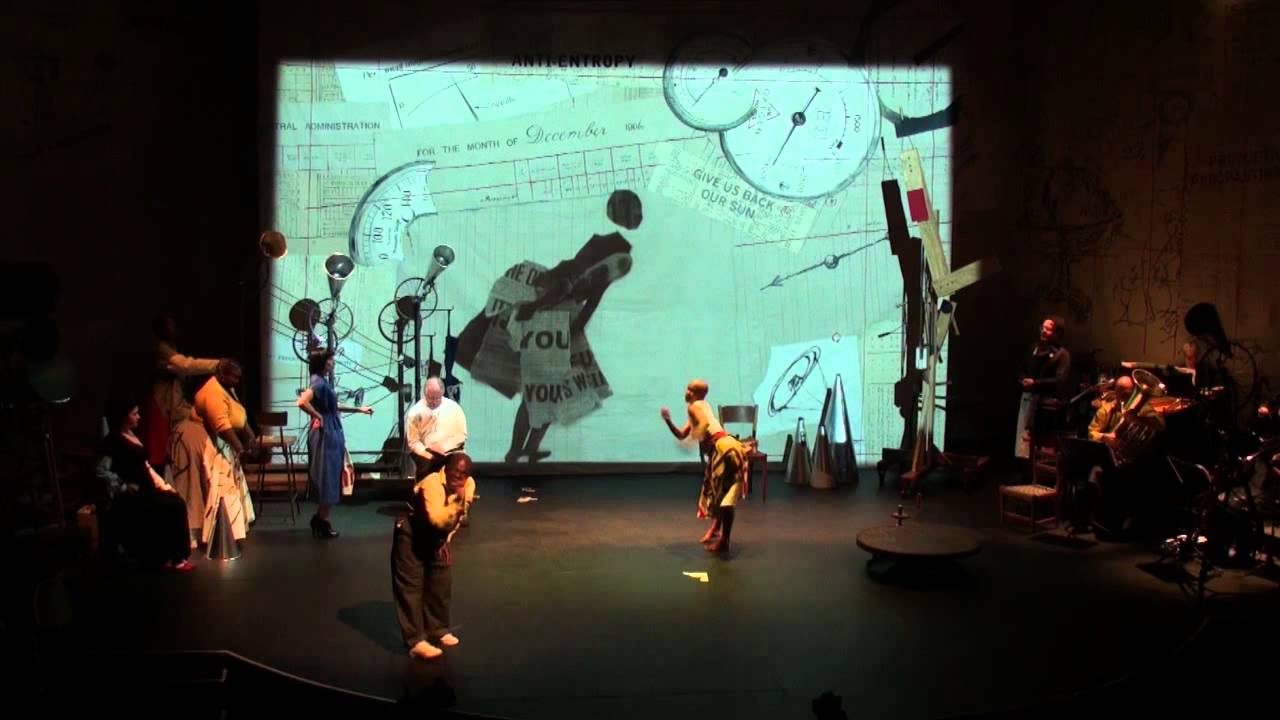
The opera Lulu at the Met in its new production by William Kentridge was an exuberant spectacle, dominantly his than of its composer Alban Berg.  Despite Marlis Petersen’s superb performance in the title role, both in singing and acting, and the powerful music under the direction of Lothat Koenigs replacing indisposed James Levine, what remained in memory was the dynamic stage display of Kentridge’s design, rapidly and incessantly changing sets composed of fragmented flats, video images, placards, masks, and the brushed drawings in process coming out of Kentridge’s own hands.  The belief underlying the production, no doubt, is opera as Gesamtkunstwerk as conceived by Richard Wagner.  I contend nonetheless that what distinguishes opera from other forms of music theater is singing to which other artistic endeavors are certainly not to be subservient but stay eager participants.  Kentridge’s so-called chamber opera at BAM earlier, Refuse the Hour, was this artist’s similarly dense multimedia spectacle but it succeeded totally because he was his own ringmaster.


It dealt with a complex idea of time, temporarity, and memory, resulting from his consultation and collaboration with the physicist Peter Galison, and the ensemble of dance, music, and singing performed on stage and the remote-controlled set of drums suspended from the loft, and Kentridge’s own sketches and collages and film clips, together with his recitation of the libretto text he wrote, worked dramatically together to expose the mystery of time — time arrested, reversed, accelerated, decelerated, elasticized, fragmented, and otherwise distorted.

But the spectacle similarly overlaid and orchestrated was just too much for an opera production, domineering our attention excessively.  Kentridge also introduced two extraneous non-singing characters, non-singing, therefore, additional visual distractions, a butler character who flittered across the stage every so often and a young woman, nominally a pianist, who sprawled on the piano most of the time and occasionally making choreographed poses.  What I found sorely missing is the clearly defined mise-en-scene for the three acts, set successively in Vienna, Paris, and London, marking Lulu’s progressive degradation.  After several viewings, with the visual novelty wearing out, we may learn to pay less attention to the stage and concentrate on the music and singing.  But I suspect it will take more than a few years of repeat performance.  William Kentridge is a great artist, visionary and inventive in his conceit, broad and profound in his socio-political perspectives, and most adroit in realizing them.  His work on Shostakovich’s opera The Nose was admirable no less than his earlier efforts Il ritorno d’Ulisse and Die Zauberflöte. It is a pity that there was no one to restrain him in this latest effort.  

Thursday, October 1, 2015

Antigone stripped down

The appearance of Juliette Binoche brought me to BAM to see her in Antigone, a Sophocles masterpiece, which I discovered only after making a reservation that Ivo van Hove directed it in Anne Carson’s new translation.  This information deflated my enthusiasm.  But, surprisingly, van Hove showed restraint quite contrary to his customary self-indulgent histrionics; the stage was bare and the actors moved sparingly; and Anne Carson’s translation, heavily edited down, followed the original closely so far as the lines she retained were concerned.  Spoken words took precedence, and that was fine; but more poetic lines were gone and so the high emotions of the drama.  The production, with its nearly exclusive focus on the theme of law and justice, was drained of flesh and bone, like the limp raincoat that represented Haimon’s bloody dead body in the last scene.  There was no tragedy in this Greek tragedy, not much Greek either in modern dress. 

Sunday, September 27, 2015

A. R. Gurney's Love & Money

True, this is not among the best of Gurney’s plays but just as delightful as any, neatly constructed with agile dialogues and peppered with wry humor, lightly satirizing the WASP as in many of his other plays.  This is not a full dinner; it is a lunch fare, simple and light but so delicious. 

Annie Baker's John


Annie Baker’s new play John is a modern masterpiece, not only as a writing, both in matter and manner, but in its realization on the stage, perfectly integrated as it is with Sam Gold’s direction and Mimi Lien’s breathtaking set representing a bed-and-breakfast guest house in Gettysburg.  These three artists together with the cast of four form a perfectly tuned quartet so beautifully balanced among themselves.  The play runs nearly three-and-a-half hours with two intermissions, and this length together with many moments of pauses and silences through the three acts made some - not a small number — in the audience restless, and some among them fled the theater during the two intermissions. 

Those long silences annoyed those who think theater is dialogue, expecting the actors to talk on incessantly as in TV sitcoms and failing to realize that in silence actors also act actively.  Pauses in John gave the play not only constituted its substance and made it so memorable; they were not only carefully calibrated but pregnant and often terribly tense and to those attuned to this pacing three hours did not feel long but continuously and excitingly mystifying. 

Most generally, the team that realized John intriguingly managed to overlay naturalism on the artifice of dramatic composition achieved the totally credible reality of never-fully-comprehensible murky complexities of human relationships, and the playwright accomplished it with only four characters in one single set.  This alone is a superb artistry.

The play opens with the owner of the B&B, Mertis Katherine Graven who calls herself “Kitty” (remarkable Georgia Engel) effortfully pushing open the stage curtain (rarely in use in contemporary plays) to reveal a huge common room extending the full width of the stage; it is studded with tchotchkes of all kinds everywhere, and, since it is as though Kitty opened the drapery of the fourth wall of the room, the audience is immediately engulfed in the milieu of the play, made to feel we are well within the room, perhaps at its far corner.  Silently, Kitty, limping lightly, shuffles about the room to turn on the music and adjust the grandfather clock to indicate the time of the scene, the action repeated at every change of the scene, one example of the artifice which is so natural that we never feel it a gimmick.  After a long silence, we finally hear a car pulling in and we hear a noise of something being knocked over outside the door.  But we never find out what it was, the first intimation of a mystery.  A 30-and something couple then arrives (Christopher Abbott and Hong Chau as Elias and Jenny); Kitty comes to open the door and meet them  but for a while no one says anything.  We wait and at long last Kitty, absent-minded, realizes her duty and indicates them to the room upstairs, a different room, unexplained, from what the couple had reserved.  We hear the loud quarreling between the man and the woman but we don’t quite hear what they are saying — another mystery.  So, in the first few minutes we find ourselves already drawn into the emotional tenor of the drama, a particular kind of anxiety and tension existing in a couple who think and want to believe they love each other and yet feel uncertain and confused and doubtful; and we wait with our own anxiety akin to that of visiting someone we have never met before and made to wait a bit too long for the host or hostess to make an appearance.  

This anxiety is the theme of the play, and it is consistently maintained and intensified as the drama progresses but at a deliberate pace with only bits and pieces of information as in real life to allow the characters to be shaped in depth, to some extent by the behavior of Elias and Jenny themselves and the strained interactions between them, like the quarrel at the breakfast table, trivial and yet revealing a deep-seated mutual discontent and Jenny’s childhood memory of an angry doll which she identifies as one of the dolls in the room, but also and more importantly by mysterious and mystifying happenings around them.  On the one hand we see more obvious strange happenings, like the player piano which starts playing by itself and the Christmas lights that go off and on, and on the other hand, and more importantly, we are exposed to Kitty’s seemingly non-consequential remarks about her sick husband we never see and her first husband long dead or her impulsive recitation of the collective names for different birds; at one point she tells us that the her inn was was a hospital during the Civil War with dismembered limbs piled high by the windows so that the room was dim.  She sounds naive or else senile, talking like a little girl, and yet she bursts out with astute observations.  After a while she is joined by her friend, Genevieve Marduk (Lois Smith), blind and unseeing but all knowing, keeps making declamatory pronouncements about her state of mental disintegration with ample self knowledge and articulate precision not just to Kitty and the suffering couple but also to the audience, whom she detains, at the end of Act II after the curtain is drawn.  Hers is a voice of the pervasive uneasy universe, so to speak; and she sits in the dark without a word while Elias and Jenny entangle on the sofa. 

As we are inexorably drawn deeper into this world of anxiety, the psychology of the story gets inexorably thicker and thicker.  In Act III, Elias sits with Kitty as the night approaches dawn and tells her his intimate and turbulent sentiment as one can only do to a virtual stranger as he would never do to anyone else; and we learn of the infidelity he suspects of Jenny on the basis of the text messages she reads but conceals from him.  In the last line spoken by Kitty who leans over to peek in Jenny’s mobile phone, we learn that the sender of the text message is John.  

The dialogues among the four characters are not only broken by pauses, long and short, but are often given in piece meal small talks, and yet they are step by step, scene by scene, calculated to deepen our anxiety, so that despite its length, we are continually kept tense, and the three-and-a-half hours zips past. Yet, on the other hand we feel as though we spent the whole stretch of events in real time because of the effect of life-like realism even though this is achieved by close calibration.  

Annie Baker's John impressed me so and I went back for the second time; and it was even better.

Tuesday, September 15, 2015

Alone at Theater

In my years of theater going, I was usually alone.  Since theater going for me is not a social entertainment as it is for many but a study project more like going to the library to read, I did not miss having a companion.  I rather liked being alone at the theater and be able to concentrate on what goes on the stage without a companionable distraction.  Moreover, sitting with someone we experience the performance separately, not together, since we don’t chat obviously as we should not.  We could engage in silent communication, like glancing at each other to frown, smile , or nod, but I am not naturally inclined to do these things either.  With a friend at a theater, we can exchange notes during the intermission or, before and after the performance if there was no intermission as is often the case with contemporary plays lasting an hour and a half or even less. 

So together with a friend at theater, we are each alone, interacting with the performers and their performance rather than with each other.  Yet together we are not really alone.  Having settled in New York, by and by I made several theater companions, some for dance, others for opera, and still others for straight theater. Then, I came to realize that there is a special pleasure in seeing a particular play together with a friend of shared taste, sitting next to each other, rather than separately on a separate night.  That is because, I believe, each live performance is unique in that the performance itself, as well as the audience, and therefore the vibration felt between them as well, is different from night to night.  Comparing notes is much more finely tuned when we see the same performance together with the same audience around us, anonymous as it is, than when we see the same play separately on different nights.  The companionship at theater, rather than a distraction, in fact can add to and enrich the pleasure of experiencing the theater by oneself. 

Friday, September 11, 2015

Authenticity, Credibility

Authenticity in acting is an oxymoron.  A person can be authentic — honest, sincere and truthful.  We can speak of the authenticity of a gem, a document, and a signature.  A product can be authentic — genuine and unadulterated, true to what it claims to be.  A painting deemed inauthentic is a copy, a replica, a workshop piece, a misattributed work, or else a work of forgery,  But acting is feigning; therefore, the performer can never be authentic nor her or his performance.  Its art consists in the ability of the actor to impersonate convincingly a character she or he is not.  If successful, the actor achieves credibility, not authenticity but a semblance of authenticity or verisimilitude. There are people who fail to see this distinction.    

It is absurd to expect an actor, who once or at the time was a hooker, promises to perform the role of a hooker better than anybody.  If she played the character convincingly, the accomplishment owes to her acting, not her other profession.  The actor can become a thug on stage or screen without being a thug in life.  

A skilled Caucasian soprano can sing Aida and Madama Butterfly and act out the characters credibly; conversely, an African American, a Native American, a Latino or Latina, or an Asian can certainly successfully sing appropriate roles in Don Giovanni and Parsifal. Similarly, a a black actor can be cast and effectively perform King Lear and Oedipus Rex.  

These are stylized dramas, of course.  But it is no different in contemporary plays and films set in the contemporary world and realistically realized.  

A controversy in Hollywood was reported recently in the New York Times article with the headline reading “Who Gets to Play the Transgender Part?” (3 September 2015).  The answer to the question is: “Anyone who can should.”   Refusing to answer the question decisively, the writer Mr. Brooks Barnes, muddled the issue.  There is no question that the movie industry should seek out and use more minority actors with more effort — Asians, Blacks, Latins, Physically Challenged, Gays, and Transgenders, but not necessarily, I argue, in their corresponding racial, ethnic, and gender roles The confusion apparently issues from the community of transgender people pressuring the industry to cast transgenders in transgender roles.  This is befuddling to say the least, or rather, downright silly, if we can assume, as I do, that a transgender man or woman striving to pass as the person of the opposite sex should welcome a non-trans actor assuming a transgender character.  

We remember Theodor Bikel, a Jew from Vienna, was a Southern sherif in The Defiant Ones, 1958, and he was credible enough to be nominated the Best Supporting Role by the Academy; and Dustin Hoffman’s autistic savant in Rain Man won him his second Oscar.  

As the Hollywood producers and directors interviewed in this article are said to have insisted: acting is acting.  Indeed.

Friday, February 6, 2015

Skits are not Plays

There was a debate today on WNYC News on the length of Broadway plays; one argued that the audience invest both money and time and long plays cost more while the other responded that investing more time is rewarded by a fuller experience.  I wrote a comment.

The classical three-act format allowed the play to unfold by developing the characters in Act I, formulating a conflict in Act II, and achieving a resolution in Act III.  An hour long performance is a skit, like a TV sitcom episode, not a theatrical play. The producers who present a play no longer than an hour and with no intermission, deploying only three, two, or even one character as they are doing more often of late are swindlers at $100 a ticket. Skits can be good, even a monologue can be good as an act of story telling or story reading.  Short stories, however good, are not novels. Audience members who get itchy to get up after an hour and are unwilling to invest more time should stay home and watch television.


Of course, small is not necessarily bad as big is not always good, and vice versa. But Eugene O’Neill’s The Iceman Cometh, the Goodman Theatre’s production at BAM Harvey, went from 7:00 to 12:00 midnight with three intermissions, and in this instance the work certainly deserved the length it required.  Hickey's extended speeches, delivered movingly by Nathan Lane in this performance, which contributed to the stretch, were worth every minute.  As the NY subway after 11:00, the schedule is irregular and truncated, I had to work out a complex itinerary with three changes and arrived home at 2:00 -- a long journey, truly A Long Night's Journey into Day.

By contrast, David Ive's Lives of the Saints, a Primary Stages production, was notable for short plays; six skits made up the program, each complete in itself and, so, without any integrating theme binding them, except for the recurrence of the same actors in repertory.  Ives is a master of punning and other word plays, and every single skit was enchanting and entertaining.  But the evening was essentially a dinner composed of appetizers and desserts without entrée. 

Wednesday, February 4, 2015

Sightreading plays

As best as I can, that is, so long as the published text is available to me, I read it before going to the performance in preparation for it.  Now, the curious thing is, if the play as performed is two hours long, it should take me as long to read it if not well within that time.  But it always takes me longer.  I am fully aware that I am not a fastest reader but I seem to read faster when I read stories, essays, and even scholarly articles.  It makes sense that, reading a play, especially in the early portion of it, like Act I, I have to sort out as I read who is who and who is saying what in what manner of behavior.  Performed on stage, these matters are visually presented and therefore effortlessly grasped.  In fact, on certain occasions, as when I am no possession of the printed play in advance, I read it after attending the play.  Then, I read quite faster.  It still irks me that I cannot read a play in one sitting the way I can watch a play in one sitting. 

Tuesday, January 27, 2015

Ostermeier's Hedda


The production of Ibsen’s Hedda Gabler that truly enraptured me was the one by Thomas Ostermeier of the Schaubühne am Lehniner Platz, Berlin, of which he became Artistic Director in 1999.  I saw it at BAM Harvey late in 2006, performed in German in a compact translation by Hinrich Schmidt-Hinkel (two hours without intermission).  The set, designed by Jan Palppelbaum, was a glass-walled modernist interior. Ostermeier set the play in this present-day residence and populated it with smartly dressed young admirers of Hedda, played by a petite gamine, Katharina Schüttler, who acted the character as suffering her ennui more passively than Ibsen had portrayed her but effectively in the director’s overall conception.  I attended the interview with Ostermeier that preceded the performance.  Asked about the idea underlying his adaptation, he said that it started with the visit to Mies van der Rohe’s Farnsworth House and hearing, in the tour of the house, about Mrs. Farnsworth’s discomfort with the house’s transparency, her desire to place bookshelves against some of the glass walls, and the architect’s adamant objection.  This, he said, made him think of Hedda’s vulnerability in being overexposed to her admirers and the ensuing anxiety, which he associated with the plight of the middle class in contemporary Germany suffering from the fear of downfall from the position of material stability.  The scene was, indeed, fraught with fragility as the characters, scattered both outside and inside at different times,  were seen reflectively sometimes from inside out and at other times outside in, as the set revolved for scene changes.  In addition, the polished floor and the slanted mirror overhead reflected the actions in uneasy inversion, adding to the feeling of instability in the relationships among the characters.  The updating to early 21st century is complete in the substitution of Lovborg’s manuscript which Hedda throws into the fire in the original is a computer file and she destroys it by hammering the laptop it is stored in.  Ostermeier earlier adapted A Doll’s House, and his version of An Enemy of the People was brought to BAM in 2013.  In the course of six years, I saw three other productions of Hedda Gabler, featuring Kate Burton (Nicholas Martin, dir.), Elizabeth Marvel (Ivo van Hove, dir.), and Cate Blanchett (Andrew Upton, dir.).  They were good in different ways in portraying the heroine; but as a production this was the most memorable.

Sunday, January 4, 2015

Theater Audience

In New York, theater still thrives and draws a large audience.  But among those who come to the theater to see a play only some can really be said to come to see the play.  There are those who come primarily to be entertained — to have a good time with friends or lovers or family; it is a night out and theater is often combined with dinner and/or drinks preceding it or following it. Theater for them is a social activity. Then, there are those who come to see the celebrities live on stage whom they were familiar with on the screen and fanatically admired.  They are predominantly tourists or members of  one fandom or another.  Broadway theaters serve these two groups.  What I believe is a relatively small minority of the audience comes really to see the play they chose to see because they wanted to see it and experience it as a theater.  This audience patronizes Off-Broadway theaters.  The audience of the Off- Off-Broadway theaters are predominantly family members and the friends of the actors in the play who come in support of the company even if obligatorily.  This is an obvious and trite observation but an observation that somehow I had to put in writing.

Happy Ending - ハッピーエンド

There are those, with or without a tragic streak in their own life, who favor a tragic twist of fortune befalling the characters in a play and dislike a happy ending perhaps out of envy or, else, missing any sympathy.  On the other hand,  there are many who prefer a happy ending for allowing them to forget their own happiness.

当人自身に不幸が有る無しに関わらず、劇中の人物が不幸に見舞われるのが好きで、ハッピーエンドで終わるのは、妬ましく思うのか、同感できないからか、好まない人がいます。その反面、不幸を忘れさせてくれるものとしてか、ハッピーエンドを好ましく思うの人も多数いますね。

Sunday, November 2, 2014

4:48 Psychosis

Sarah Kane’s 4:48 Psychosis, as adapted and directed by Grzegorz Jarzyna of the WR Warszawa and performed in Polish, I summarize in two words: hysterically overdramatized.  Since Kane’s text for this psychological exploration lacks stage direction of any kind, it is a play that lends itself to a wide variety of interpretations, and as such Jarzyna’s might be said to be just another one.  It is a striking contrast, nonetheless, to the French production from ten years ago which featured Isabelle Huppert, under the direction of Claude Régy, with just Gérard Watkins as her foil as opposed to Jarzyna’s stage populated with with six actors.  Perhaps underdramatized by comparison, it was, in my view, much more successful because it was replete with pain expressed in silences rather than in wailing.

Thursday, October 2, 2014

Poems staged, Plays recited

For many years TACT the Actors Theatre Company has been offering rehearsed but unstaged reading of plays four times every season for its subscribers in what it called the Salon Series.  Other companies have been doing similar events more recently.  I get a tremendous satisfaction from these performances in which the actors, seated or standing, read from the script held in hand.  Far from seeming or sounding incomplete or preliminary like the first rehearsal, the plays recited on stage without the paraphernalia of set, property, or costume tease and engage the imagination of the audience, the way radio plays I grew up on in my teens back in Japan did; and therein lies, I am convinced, their very special attraction. 

Recently, I attended riverrun, the multimedia staging of the last pages of James Joyce’s Finnegans Wake, adapted, directed, and performed by Olwen Fouéré, actor and performance artist from Dublin.  In her performance she was superb, highly disciplined, articulate and expressive, quite engaging all along the 60-minute event.   Still, I felt — to put it bluntly — cheated.  So much of the richness of Joyce’s exceptional writing was obscured by the actor’s vocalizing and acting.  For one, given the nature of the meditative soliloquy, almost a dream, declaiming it as a public enactment goes perversely against the character of the writing.  I wrote previously on Fiona Shaw’s staged reading of Coleridge’s The Rime of the Ancient Mariner, accompanied by the dancer Daniel Hay-Gordon, the theatricality of which detracted from the poem’s already amply dramatic text.  With Finnegans Wake, the staging was even more detracting.  Joyce’s prose is surely melodic, and his puns are often clearer when read aloud and heard as his own reading attests.  But Joyce also writes many visual puns and they are lost when the text is not followed by the eye.  Poems can be recited as Dylan Thomas, for example, did so inimitably and effectively; but they alter the work substantially when staged.  
One can, of course, call staged readings of poems adaptations.  Adaptations, as from stage to screen or vice versa, or from the novel to the stage or screen, are always new works in a new genre, removed from the original except in its most basic components and should not be judged by the standard set by it.  Granting this, then, staged reading as an adaptation should be taken for what it is; riverrun was so designated, The Rime was not. 
The day after riverrun, I attended Beckett’s Embers, another multimedia presentation by PanPan Theatre, which consisted of a colossal wooden sculpture of a skull which moved and illuminated variously through the performance; two actors read the lines mostly inhabiting the interior of the skull behind the eye sockets, and an elaborate sound design created a complex multilayered auditory environment.  Gavin Quinn, director, spoke of the work as “an installation of sculpture with words.”  Ironically, Embers was Beckett’s 1959 radio play, that would have fully engaged the imagination of the listeners hearing only words and sound effects.  At least, the company described the play was as Embers reimagined.  It was also reconstituted, not for the better in my opinion.